
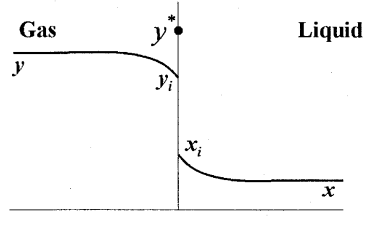
A gas mixture is in contact with a liquid. Component P in the gas mixture is highly soluble in the liquid. Possible concentration profiles during absorption of P are shown in the choices, where $x$: mole fraction of P in bulk liquid $y$: mole fraction of P in bulk gas $x_i$: mole fraction of P at the interface in liquid $y_i$: mole fraction of P at the interface in gas $y^*$: equilibrium gas phase mole fraction corresponding to $x_i$ The CORRECT profile is
Understanding Gas Absorption Concentration Gradients
The question describes the absorption of component P from a gas mixture into a liquid. Component P is noted as highly soluble in the liquid. This means P preferentially transfers into and remains within the liquid phase.
Required Concentration Profiles for Absorption
For absorption (transfer from gas to liquid) to occur, specific concentration gradients must exist across the gas-liquid interface:
- Gas Phase: The concentration (mole fraction) of P must be higher at the interface than in the bulk gas to drive diffusion away from the interface. Therefore, $y_i > y$.
- Liquid Phase: The concentration (mole fraction) of P must be lower at the interface than in the bulk liquid. P moves into the liquid and becomes incorporated, increasing its concentration towards the bulk. Therefore, $x_i < x$.
- Equilibrium Condition: The composition at the interface must satisfy equilibrium relationships. For absorption to proceed, the gas phase concentration at the interface ($y_i$) must exceed the equilibrium concentration ($y^*$) corresponding to the liquid interface concentration ($x_i$). Thus, $y_i > y^*$.
Identifying the Correct Profile
Based on the required gradients and equilibrium condition:
- The concentration of P should decrease from the interface to the bulk in the gas phase ($y_i > y$).
- The concentration of P should increase from the interface to the bulk in the liquid phase ($x_i < x$).
- The gas phase interface concentration must be greater than the equilibrium value ($y_i > y^*$).
Profile D shows:
- $y_i > y$ (Correct gas phase gradient)
- $x_i < x$ (Correct liquid phase gradient)
- $y_i > y^*$ (Correct equilibrium driving force)
This profile accurately represents the conditions for the absorption of a soluble gas like component P.
Important Questions from Absorption
- A gas stream with $2.01 \text{ mol }\%$ ammonia is to be scrubbed in a counter-current isothermal packed bed absorber using pure water to reduce its concentration to $0.01 \text{ mol }\%$. Assume that dilute conditions apply, operating line is linear and the mass transfer coefficients are constant throughout the column. The liquid and the gas flows inside the absorber (in $\text{kmol m}^{-2}\text{ h}^{-1}$) are 1000 and 200, respectively. The equilibrium relationship is $y = 0.9 x$, where, $y$ is the mole-fraction of ammonia in the gas phase and $x$ is that in the liquid. Under these conditions, the height of overall gas transfer unit ($H_{tOG}$) is $0.8 \text{ m}$ and the number of overall gas transfer units ($N_{tOG}$) is given by the following integral.
$$ N_{tOG} = \int_{y_1}^{y_2} \frac{dy}{y - y^*} $$
The integration is performed between the two ends of the column, and $y^*$ is the equilibrium mole fraction in the gas phase, corresponding to the composition of the liquid at corresponding location. Which one of the following is the minimum length of the packing (in m) necessary to achieve the desired scrubbing? Benzene is removed from air by absorbing it in a non-volatile wash-oil at 100 kPa in a counter-current gas absorber. Gas flow rate is 100 mol/min, which includes 2 mol/min of benzene. The flow rate of wash-oil is 50 mol/min. Vapor pressure of benzene at the column conditions is 50 kPa. Benzene forms an ideal solution with the wash-oil and the column is operating at steady state. Gas phase can be assumed to follow ideal gas law. Neglect the change in molar flow rates of liquid and gas phases inside the column.
For this process, the value of the absorption factor (up to two decimal places) is ________________- A liquid $L$ containing a dissolved gas $S$ is stripped in a countercurrent operation using a pure carrier gas $V$. The liquid phase inlet and outlet mole fractions of $S$ are $0.1$ and $0.01$, respectively. The equilibrium distribution of $S$ between $V$ and $L$ is governed by $y_e = x_e$, where $y_e$ and $x_e$ are the mole fractions of $S$ in $V$ and $L$, respectively. The molar feed rate of the carrier gas stream is twice as that of the liquid stream. Under dilute solution conditions, the minimum number of ideal stages required is ________ (in integer).
- Pure gas P is being absorbed into a liquid. The dissolved P undergoes an irreversible reaction in the liquid film. The reaction is first order with respect to P. Which one of the following represents the concentration profile of P in the liquid film at steady state?
A countercurrent absorption tower is designed to remove 95% of component A from an incoming binary gas mixture using pure solvent B. The mole ratio of A in the inlet gas is 0.02. The carrier gas flow rate is 50 kmol/h. The equilibrium relation is given by $Y = 2X$, where Y and X are the mole ratios of A in the gas and liquid phases, respectively. If the tower is operated at twice the minimum solvent flow rate, the mole ratio of A in the exit liquid stream is ________ (rounded off to three decimal places).


