
A force of 1000 N is acting at point A on a bracket fixed at point B as shown in the figure. The magnitude of the moment of the force about B (in N·m) is __________. (Rounded off to one decimal place)
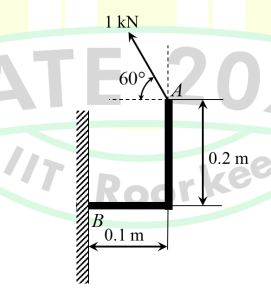
The moment of a force about a point is calculated using the formula M = F × d, where F is the force and d is the perpendicular distance from the point to the line of action of the force.
Given:
Force, F = 1000 N (1 kN = 1000 N)
Vertical distance from A to B, h = 0.2 m
Horizontal distance from B to the vertical line through A, w = 0.1 m
Angle, θ = 60°
To find the perpendicular distance, use the perpendicular components of the force:
d = h·cos(θ) + w·sin(θ)
Calculating each component:
h·cos(θ) = 0.2·cos(60°) = 0.2·0.5 = 0.1 m
w·sin(θ) = 0.1·sin(60°) = 0.1·(√3/2) ≈ 0.0866 m
The total perpendicular distance is:
d = 0.1 + 0.0866 = 0.1866 m
Now, calculate the moment:
M = 1000 · 0.1866 = 186.6 N·m
The moment of the force about B is 186.6 N·m, which falls within the provided range of 185 to 188 N·m.
Important Questions from Equilibrium
What is the pH of a solution prepared by dissolving $0.0025$ moles of $HNO_3$ in $250\,mL$ of water?
Which species acts as acid like behaviour in the following reaction?
\(HPO_4^{2-}+NH_4^{1+}\rightarrow H_2PO_4^{1-}+NH_3\)
Aqueous solution of CH 3COONa is:
pH of a neutral solution is ___________.
For the reaction N 2(g) + 3H 2(g) \(\rightleftharpoons\) 2NH 3(g) ΔH = -ve :


