
A feedback control system is shown in the figure.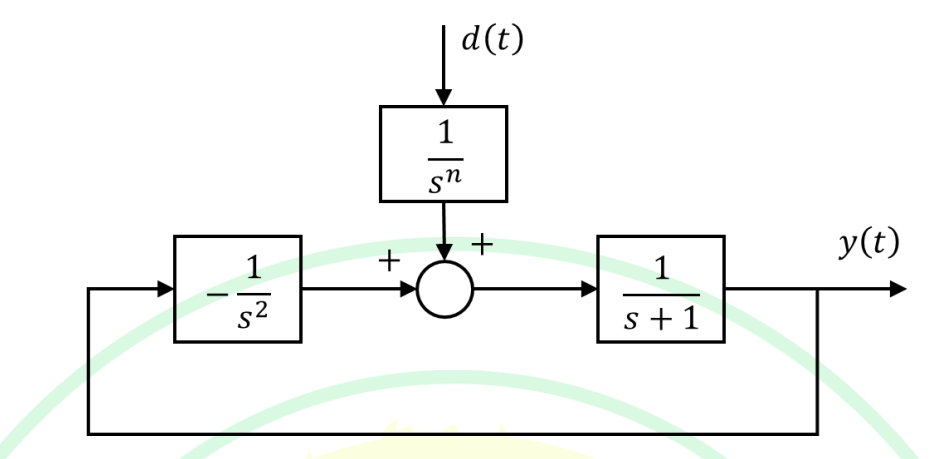
The maximum allowable value of n such that the output $y(t)$, due to any step disturbance signal $d(t)$, becomes zero at steady-state, is _________ (in integer).
To find the maximum allowable value of n such that the output y(t) due to any step disturbance signal d(t) becomes zero at steady-state, we analyze the closed-loop feedback control system. Consider a disturbance d(t) with Laplace transform D(s)=1/sn.
For steady-state analysis, we examine the type of the system. The open-loop transfer function G(s)H(s) is given by:
G(s)H(s)=\(\dfrac{1}{s+1}\times\dfrac{1}{s^2}\)=\dfrac{1}{s^3(s+1)}
The type of system is determined by the number of integrators (poles at origin). Here, it’s of type 3 since there are three poles at the origin. The disturbance d(t)=1/sn becomes a step disturbance when n=1.
For a type k system to achieve zero steady-state error with a disturbance of the form 1/sn, the condition is n ≤ k. Therefore, for zero steady-state error with d(t)=1/s1 and a type 3 system:
1 ≤ 3
Thus, the maximum allowable value of n is 1.
Finally, the computed value n=1 falls within the given range (1,1), confirming correctness.
Important Questions from Steady State Error
The steady-state error due to unit step input to a type-1 system is:
With reference to the error analysis of the control systems, the term 'acceleration error constant' stands for:
Which one of the following coefficient is associated with Unit Ramp function?
If the output of the system at steady state does not agree with the input, then the system is said to have _________ which determines the _________ of the system.
A unity negative feedback closed loop system has a plant with the transfer function \(G(s) = \dfrac{1}{s^2 + 2s + 2}\) and a controller Ge(s) in the feedforward path. For a unit step input, the transfer function of the controller that gives minimum steady slate error is


