Surface Cubes Calculation
The problem asks for the number of small cubes with a side length of 1 cm that are visible on the surface of a larger cube with a side length of 3 cm, formed by assembling these small cubes.
Total Number of Small Cubes
A larger cube with a side length of 3 cm is constructed from smaller cubes of side length 1 cm. The total number of small cubes is calculated as:
$ \text{Total Cubes} = (\text{Side length of large cube})^3 = (3 \text{ cm})^3 = 3 \times 3 \times 3 = 27 $
Number of Inner Cubes
The small cubes that are *not* on the surface form a smaller inner cube. The side length of this inner cube is the side length of the large cube minus 2 (1 cm from each opposite side).
$ \text{Side length of inner cube} = (\text{Side length of large cube}) - 2 = 3 \text{ cm} - 2 = 1 \text{ cm} $
The number of small cubes forming the inner, unexposed part is:
$ \text{Inner Cubes} = (1 \text{ cm})^3 = 1 \times 1 \times 1 = 1 $
Number of Surface Cubes
The number of small cubes visible on the surface is the total number of small cubes minus the number of inner cubes.
$ \text{Surface Cubes} = \text{Total Cubes} - \text{Inner Cubes} $
$ \text{Surface Cubes} = 27 - 1 = 26 $
Therefore, 26 small cubes can be counted on the surface.
Important Questions from Cube And Dice (Notes)
A cube has six different symbols drawn over its six faces. The symbols are dot, circle, triangle, square, cross and arrow. Three different positions of the cube are shown in the figures.
Which symbol is opposite the Square?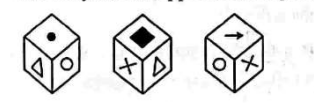
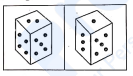
Study the two different positions of a cube given below with dots from 1 to 6 marked on its faces. Find out how many dots are there on the face opposite to that containing 4 dots.
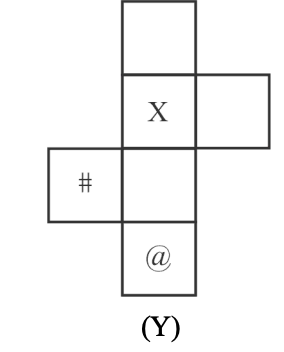
Choose the box that is similar to the box formed from the given sheet of paper (Y).