
A controller $D(s)$ of the form $(1 + K_D s)$ is to be designed for the plant $G(s) = \frac{1000\sqrt{2}}{s(s+10)^2}$ as shown in the figure. The value of $K_D$ that yields a phase margin of 45° at the gain cross-over frequency of 10 rad/sec is ___________ (round off to one decimal place).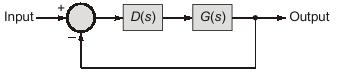
This problem requires finding the derivative gain $K_D$ for a Proportional-Derivative (PD) controller $D(s)$ such that the closed-loop system meets a specific phase margin requirement at a given gain crossover frequency ($\omega_{gc}$).
1. Define the Open Loop Transfer Function $L(s)$
The open-loop transfer function is $L(s) = D(s)G(s)$.
$$D(s) = 1 + K_D s$$ $$G(s) = \frac{1000\sqrt{2}}{s(s+10)^2}$$ $$L(s) = \frac{1000\sqrt{2} (1 + K_D s)}{s(s+10)^2}$$
2. Apply the Gain Crossover Condition
The gain crossover frequency is given as $\omega_{gc} = 10 \text{ rad/sec}$. By definition, the magnitude of the open-loop transfer function must be unity (or 0 dB) at this frequency:
$$|L(j\omega_{gc})| = 1$$
Substitute $s = j\omega_{gc} = j10$ into the magnitude expression for $L(s)$:
$$|L(j10)| = \frac{1000\sqrt{2} |1 + j10 K_D|}{|j10| |j10 + 10|^2} = 1$$
Calculate the denominators:
$$|j10| = 10$$ $$|j10 + 10|^2 = |10(1 + j1)|^2 = 100 \cdot (\sqrt{1^2 + 1^2})^2 = 100 \cdot 2 = 200$$
$$|L(j10)| = \frac{1000\sqrt{2} \sqrt{1 + (10 K_D)^2}}{10 \cdot 200} = 1$$ $$\frac{1000\sqrt{2} \sqrt{1 + 100 K_D^2}}{2000} = 1$$ $$\frac{\sqrt{2} \sqrt{1 + 100 K_D^2}}{2} = 1$$
Square both sides:
$$\frac{2 (1 + 100 K_D^2)}{4} = 1$$ $$\frac{1 + 100 K_D^2}{2} = 1$$ $$1 + 100 K_D^2 = 2$$ $$100 K_D^2 = 1$$ $$K_D^2 = 0.01$$ $$K_D = 0.1$$
3. Apply the Phase Margin Condition (Self-Check)
The phase margin ($PM$) is given as $45^\circ$. It is defined as:
$$PM = 180^\circ + \angle L(j\omega_{gc})$$
We need $PM = 45^\circ$, so the phase angle must be $\angle L(j10) = 45^\circ - 180^\circ = -135^\circ$.
The phase angle contribution from the original plant $G(s)$ at $\omega=10$ is:
$$\angle G(j10) = \angle \left( \frac{1}{j10 (j10 + 10)^2} \right)$$ $$\angle G(j10) = -90^\circ - 2 \cdot \angle (10 + j10)$$ $$\angle G(j10) = -90^\circ - 2 \cdot (45^\circ) = -180^\circ$$
The phase angle of the controlled system $L(s)$ is:
$$\angle L(j10) = \angle D(j10) + \angle G(j10)$$ $$\angle L(j10) = \angle (1 + j10 K_D) + (-180^\circ)$$
We require $\angle L(j10) = -135^\circ$.
$$-135^\circ = \angle (1 + j10 K_D) - 180^\circ$$ $$\angle (1 + j10 K_D) = 180^\circ - 135^\circ = 45^\circ$$
The phase lead $\phi_D$ provided by the controller is $\phi_D = 45^\circ$.
$$\phi_D = \arctan(10 K_D / 1)$$ $$\tan(45^\circ) = 10 K_D$$ $$1 = 10 K_D$$ $$K_D = 0.1$$
Both the gain crossover condition and the phase margin condition yield the same result, $K_D = 0.1$.
4. Final Result
The value of $K_D$ is $0.1$. Rounding off to one decimal place, the answer is 0.1.
Important Questions from Controllers and Compensators
Given below are two statements:
Statement I: In proportional control, the actuating signal for the control action in a control system is proportional to the error signal
Statement II: It is desirable that control system be over damped for the point of view of quick response
In the light of the above statements, choose thecorrectanswer from the options given below:
Which of the following controllers improves the transient response of a system?
The transfer function of the lead compensator is:
Which of the following terms is responsible for noise measurement in the PID controller?
The overall transfer function of a control system is given by the following equation. Find out the value of Derivative rate feedback constant K t. (Consider the Damping ratio 0.9)
\(\dfrac{C(s)}{R(s)}= \dfrac{36}{s^2+3.6s+36}\)


