
A circuit using an ideal OP-AMP is shown in the Figure.
Which of the following options gives the correct value of the current $I_X$?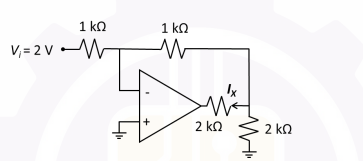
To find the current \( I_X \) in the given OP-AMP circuit, we need to understand how the ideal operational amplifier works. An ideal OP-AMP has infinite input impedance, zero output impedance, and infinite gain. For an ideal OP-AMP, the voltage difference between the inverting \((-)\) and non-inverting \( (+) \) inputs is zero when in closed-loop configuration (virtual short concept).
Given the circuit:
We can analyze the circuit step-by-step:
- The non-inverting input is grounded; hence it is at 0 V.
- Due to the virtual short between the non-inverting and inverting inputs, the inverting input is also at 0 V.
- Apply Kirchhoff's Voltage Law (KVL) around the input loop: \(V_i - I_1 \cdot 1\, \text{k}\Omega - I_1 \cdot 1\, \text{k}\Omega = 0\) where \(V_i = 2 \, \text{V}\).
- Solving for \(I_1\), we get: \(I_1 = \frac{2 \, \text{V}} {2\, \text{k}\Omega} = 1 \, \text{mA}\).
- This current \(I_1\) flows into the 2 kΩ resistor connected to \( I_X\). Therefore, the current through the feedback path (including the two 2 kΩ resistors) is the same as \(I_1\).
- Since the resistors are identical (2 kΩ each), and they are in series, the voltage across each is \(V = I \cdot R = 1 \, \text{mA} \times 2\, \text{k}\Omega = 2 \, \text{V}\).
- The total current \(I_X\) flowing through the series arrangement of the two 2 kΩ resistors is equal and given by: \(2 \, \text{mA} + 1 \, \text{mA} = 3 \, \text{mA}\).
Therefore, the value of the current \( I_X \) is 3.0 mA.
Important Questions from Op Amp Circuit Calculations
The op-amps in the following circuit are ideal. The voltage gain of the circuit is _________ . (Round off to the nearest integer)
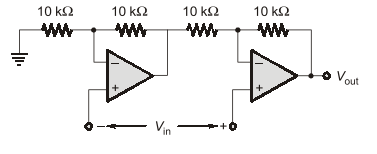
The voltage gain $A_v$ of the circuit shown below is
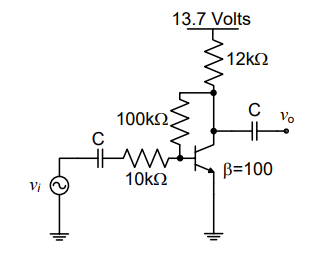
Assuming base-emitter voltage of $0.7 \text{ V}$ and $\beta = 99$ of transistor $Q_1$, the output voltage $V_o$ in the ideal opamp circuit shown below is
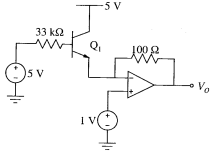
In the circuit shown, the open loop gain of the operational amplifier is $A_0 = 10^5$.
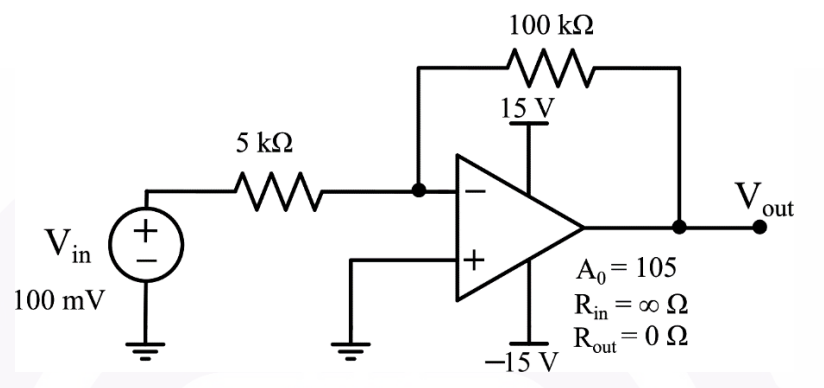
What is the voltage gain of the circuit?
(Round off to two decimal places)


