
A Boolean function, $f(x,y,z)$ with $x$ as MSB and $z$ as LSB is realized by 4:1 multiplexer (MUX) with select lines, $S_1$ and $S_0$ ( $S_1$ is MSB, $S_0$ is LSB) and inputs, $I_0$, $I_1$, $I_2$, $I_3$ as shown in the Figure.
Which of the following options is the correct expression of $f(x,y,z)$?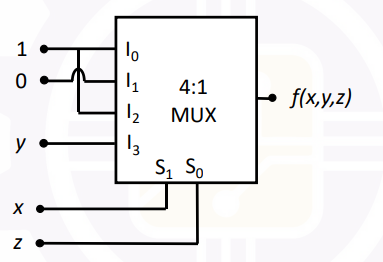
To solve this problem, we need to understand how the Boolean function \(f(x, y, z)\) is realized using a 4:1 multiplexer (MUX).
The configuration given shows a 4:1 MUX with select lines \(S_1\) and \(S_0\), where \(S_1\) is the most significant bit (MSB) and \(S_0\) is the least significant bit (LSB).
- The inputs to the MUX are:
- \(I_0 = 1\)
- \(I_1 = 0\)
- \(I_2 = y\)
- \(I_3 = z\)
- The select lines are given as:
- \(S_1 = x\)
- \(S_0 = z\)
The output \(f(x, y, z)\) depends on the values of \(S_1\) and \(S_0\), which select one of the four inputs:
| \(S_1S_0\) | Selected Input |
|---|---|
| \(00\) | \(I_0 = 1\) |
| \(01\) | \(I_1 = 0\) |
| \(10\) | \(I_2 = y\) |
| \(11\) | \(I_3 = z\) |
We need to evaluate \(f(x, y, z)\) for different values of \(x\) and \(z\):
- When \(x = 0, z = 0\): \(f(0, y, 0) = I_0 = 1\)
- When \(x = 0, z = 1\): \(f(0, y, 1) = I_1 = 0\)
- When \(x = 1, z = 0\): \(f(1, y, 0) = I_2 = y\)
- When \(x = 1, z = 1\): \(f(1, y, 1) = I_3 = z\)
Therefore, the function is described as:
\(f(x, y, z) = (\bar{x} \bar{z}) \cdot 1 + (\bar{x} z) \cdot 0 + (x \bar{z}) \cdot y + (x z) \cdot z\)
Which simplifies to:
\(f(x, y, z) = (\bar{x} \bar{z}) + (x \bar{z}) y + (x z) z\)
Further simplification results in:
\(f(x, y, z) = \bar{z} + xy\)
This matches with the given option \(xy + \bar{z}\).
Thus, the correct solution is:
Correct Answer: \(xy + \bar{z}\)
Important Questions from Multiplexer
Consider the digital circuit shown below with two input lines A and B, two select lines S0 and S1, and an output line Y. The blocks Q and M represent active high 2:4 decoder and 4-to-1 multiplexer, respectively. Out of 16 possible input combinations, the number of combinations that produce Y=1 is ____________. (answer in integer)
Note: One input combination is an instance of [A B S1 S0].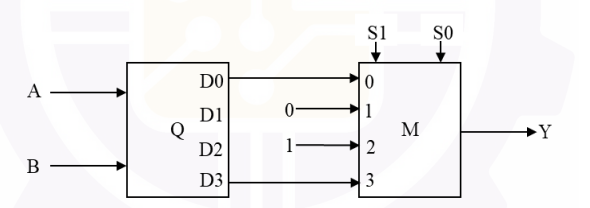
- Match the LIST-I with LIST-IIChoose the correct answer from the options given below:
LIST-I LIST-II A. F(A,B,C,D) = $\sum$ (1,3, 4,11,12,13,14,15) I. 8$\times$1MUX B. F(A,B,C) = $\sum$ (1,2,6,7) II. 4$\times$1MUX C. F(A,B,C) = $\sum$ (1,3,5,7) III. 4$\times$1MUX and 1 NOT gate D. F(A,B,C,D) = $\sum$ (1,3,5,7,9,11,13,15) IV. 8$\times$1MUX and 1 NOT gate Consider the following statements :
A multiplexer :
1. selects one of the several inputs and transmits it to a single output.
2. routes the data from a single input to one of many outputs.
3. converts parallel data into serial data.
4. is a combinational circuit.Which of these statements are correct ?
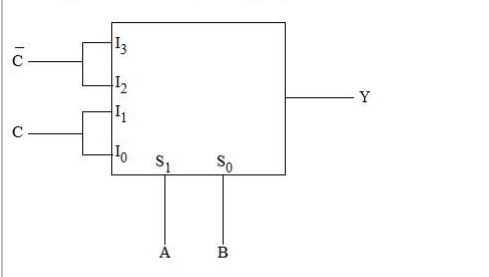
For the given 4 × 1 MUX, the output y is
Following multiplexers have to be designed by different MUX. Arrange the number of MUX required in descending order
A. Construct 4 : 1 MUX by using 2 : 1 MUX
B. Construct 16 : 1 MUX by using 4 : 1 MUX
C. Construct 64 : 1 MUX by using 4 : 1 MUX
D. Construct 64 : 1 MUX by using 8 : 1 MUX
E. Construct 256 : 1 MUX by using 8 : 1 MUX
Choose the correct answer from the options given below :


