
A 4-bit weighted-resistor DAC with inputs $b_3$, $b_2$, $b_1$, and $b_0$ (MSB to LSB) is designed using an ideal opamp, as shown below. The switches are closed when the corresponding input bits are logic '1' and open otherwise. When the input $b_3 b_2 b_1 b_0$ changes from 1110 to 1101, the magnitude of the change in the output voltage $V_O$ (in mV, rounded off to the nearest integer) is ________.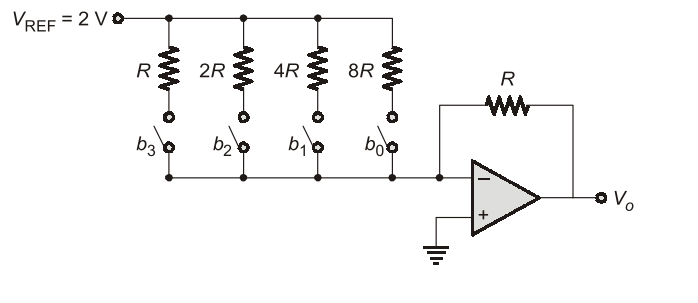
The circuit is a 4-bit weighted-resistor Digital-to-Analog Converter (DAC) using an inverting Op-Amp. The output voltage ($V_O$) is proportional to the weighted sum of the input bits.
1. Output Voltage Formula
The output voltage $V_O$ of an inverting summing amplifier DAC is given by:
$$V_O = -V_{\text{REF}} \cdot \frac{R_f}{R} \sum_{i=0}^{N-1} b_i 2^{i-N}$$
Alternatively, in terms of the input resistors $R_i$ and feedback resistor $R_f$:
$$V_O = -R_f \cdot V_{\text{REF}} \sum_{i=0}^{N-1} \frac{b_i}{R_i}$$
Here, $N=4$ bits ($b_3$ is MSB, $b_0$ is LSB). The input resistors are $R_3=R, R_2=2R, R_1=4R, R_0=8R$. The feedback resistor is $R_f=R$. $V_{\text{REF}} = 2 \text{ V}$.
$$V_O = -R \cdot V_{\text{REF}} \left( \frac{b_3}{R} + \frac{b_2}{2R} + \frac{b_1}{4R} + \frac{b_0}{8R} \right)$$ $$V_O = -V_{\text{REF}} \left( b_3 + \frac{b_2}{2} + \frac{b_1}{4} + \frac{b_0}{8} \right)$$ $$V_O = -V_{\text{REF}} \left( \frac{8b_3 + 4b_2 + 2b_1 + b_0}{8} \right)$$
2. Calculate Output for Input 1 ($V_{O1}$ for $1110$)
Input $b_3 b_2 b_1 b_0 = 1110$. $V_{\text{REF}} = 2 \text{ V}$.
$$V_{O1} = -2 \text{ V} \left( \frac{8(1) + 4(1) + 2(1) + 1(0)}{8} \right)$$ $$V_{O1} = -2 \cdot \left( \frac{8 + 4 + 2}{8} \right) = -2 \cdot \frac{14}{8}$$ $$V_{O1} = -2 \cdot 1.75 = -3.50 \text{ V}$$
3. Calculate Output for Input 2 ($V_{O2}$ for $1101$)
Input $b_3 b_2 b_1 b_0 = 1101$. $V_{\text{REF}} = 2 \text{ V}$.
$$V_{O2} = -2 \text{ V} \left( \frac{8(1) + 4(1) + 2(0) + 1(1)}{8} \right)$$ $$V_{O2} = -2 \cdot \left( \frac{8 + 4 + 1}{8} \right) = -2 \cdot \frac{13}{8}$$ $$V_{O2} = -2 \cdot 1.625 = -3.25 \text{ V}$$
4. Calculate the Magnitude of the Change in Output Voltage ($\Delta V_O$)
$$\Delta V_O = |V_{O2} - V_{O1}|$$ $$\Delta V_O = |-3.25 \text{ V} - (-3.50 \text{ V})|$$ $$\Delta V_O = |-3.25 + 3.50| \text{ V} = 0.25 \text{ V}$$
5. Convert to $\text{mV}$ and Round
The result is required in $\text{mV}$ ($1 \text{ V} = 1000 \text{ mV}$), rounded off to the nearest integer.
$$\Delta V_O = 0.25 \text{ V} \times 1000 \frac{\text{mV}}{\text{V}} = 250 \text{ mV}$$
Rounding to the nearest integer gives 250.
Important Questions from Digital To Analog Converters
A D/A converter has 5V full-scale input voltage and an accuracy of ± 0.2%. The maximum error for any output voltage will be
An ideal 6-bit DAC with zero offset gives output voltage of 0.1 V for an input ‘000010’. What is the output for input ‘001010'
Identify the most significant bit from the '100010' binary data.
Two 10-bit ADCs, one of successive approximation type and other of single slope integrating type, take Ta and Tb time respectively to convert 3V analog input signal to digital output. If the input analog signal is increased to 6V, the approximate time taken by the two ADCs will respectively be
The resolution of $4\frac{1}{2}$-digit voltmeter is:


