All Exams Test series for 1 year @ ₹349 only

JEE Main 2022 Question Paper with Solutions (28-Jun-2022) (Shift 2); Download PDF

JEE Main 2022 Question Paper with Solutions for Jun 28, 2022 Shift 2 is available here for PDF download and can also be attempted in a test format for practice. JEE Main Paper 1 (B.E./B.Tech) is conducted in CBT mode and includes Physics, Chemistry, and Mathematics.

Free
JEE Main 2022 Question Paper (28-Jun-2022) (Shift 2)
180 Minutes
90 Questions
300 Marks
English
Showing 1 - 5 of 20 questions
Page 1 of 4

Q1.

Velocity \( \left(v\right) \) and acceleration \( \left(a\right) \) in two systems of units 1 and 2 are related as \( v_{2} = \frac{n}{m^{2}} v_{1} \) and \( a_{2} = \frac{a_{1}}{mn} \) respectively. Here \( m \) and \( n \) are constants. The relations for distance and time in two systems respectively are

Q2.

A ball is spun with angular acceleration \( \alpha = 6t^{2} - 2t \) where \( t \) is in seconds and \( \alpha \) is in \( \mathrm{rad} \, \mathrm{s}^{-2} \). At \( t = 0 \), the ball has an angular velocity of \( 10 \, \mathrm{rad} \, \mathrm{s}^{-1} \) and an angular position of \( 4 \, \mathrm{rad} \). The most appropriate expression for the angular position of the ball is

Q3.

A block of mass $2  \mathrm{kg}$ moving on a horizontal surface with speed of $4  \mathrm{m}  \mathrm{s}^{-1}$ enters a rough surface ranging from $x = 0.5   \mathrm{m}$ to $x = 1.5   \mathrm{m}$. The retarding force in this range of rough surface is related to distance by $F = -kx$ where $k = 12  \mathrm{N}  \mathrm{m}^{-1}$. The speed of the block as it just crosses the rough surface will be

Q4.

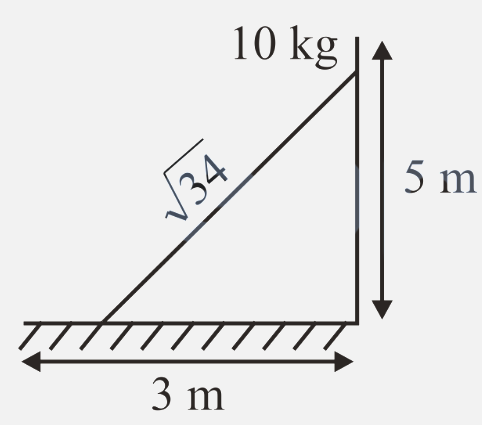
A $\sqrt{34}  \mathrm{m}$ long ladder weighing $10  \mathrm{kg}$ leans on a frictionless wall. Its feet rest on the floor $3  \mathrm{m}$ away from the wall as shown in the figure. If $F_{f}$ and $F_{w}$ are the reaction forces of the floor and the wall, then the ratio of $\frac{F_{w}}{F_{f}}$ will be:
(Use $g = 10  \mathrm{m}  \mathrm{s}^{-2}$.)
Q5.

Water falls from a $40 \quad \mathrm{m}$ high dam at the rate of $9 \times 10^{4} \quad \mathrm{kg}$ per hour. Fifty percent of gravitational potential energy can be converted into electrical energy. Using this hydroelectric energy, the number of $100 \quad \mathrm{W}$ lamps that can be lit is:
(Take $g = 10 \quad \mathrm{m} \quad \mathrm{s}^{-2}$)

Page 1 of 4
Need Expert Advice?