All Exams Test series for 1 year @ ₹349 only

JEE Main 2019 Question Paper with Solutions (10-Jan-2019) (Shift 2); Download PDF

JEE Main 2019 Question Paper with Solutions for Jan 10, 2019 Shift 2 is available here for PDF download and can also be attempted in a test format for practice. JEE Main Paper 1 (B.E./B.Tech) is conducted in CBT mode and includes Physics, Chemistry, and Mathematics.

Free
JEE Main 2019 Question Paper (10-Jan-2019) (Shift 2)
180 Minutes
90 Questions
360 Marks
English
Showing 1 - 5 of 30 questions
Page 1 of 6

Q1.

An unknown metal of mass $192 \mathrm{g}$ heated to a temperature of $100 °\mathrm{C}$ was immersed into a brass calorimeter of mass $128 \mathrm{g}$ containing $240 \mathrm{g}$ of water at a temperature of $8.4 °\mathrm{C}$. Calculate the specific heat of the unknown metal if the water temperature stabilizes at $21.5°\mathrm{C}$. (Specific heat of brass is $394 \mathrm{J} \mathrm{kg}^{-1}\mathrm{K}^{-1}$.)

Q2.

Two vectors $\overrightarrow{A}$ and $\overrightarrow{B}$ have equal magnitudes. The magnitude of $\left(\overrightarrow{A} + \overrightarrow{B}\right)$ is $n$ times the magnitude of $\left(\overrightarrow{A} - \overrightarrow{B}\right)$. The angle between $\overrightarrow{A}$ and $\overrightarrow{B}$ is:

Q3.

A parallel plate capacitor having capacitance \(12\,\mathrm{pF}\) is charged by a battery to a potential difference of \(10\,\mathrm{V}\) between its plates. The charging battery is now disconnected and a porcelain slab of dielectric constant \(6.5\) is slipped between the plates. The work done by the capacitor on the slab is

Q4.

A closed organ pipe has a fundamental frequency of $1.5\,\mathrm{kHz}$. The number of overtones that can be distinctly heard by a person with this organ pipe will be $n$, where $n$ satisfies the condition that the frequency of the $n$-th overtone is less than or equal to $20,000\,\mathrm{Hz}$ (Assume that the highest frequency a person can hear is $20,000\,\mathrm{Hz}$).

Q5.

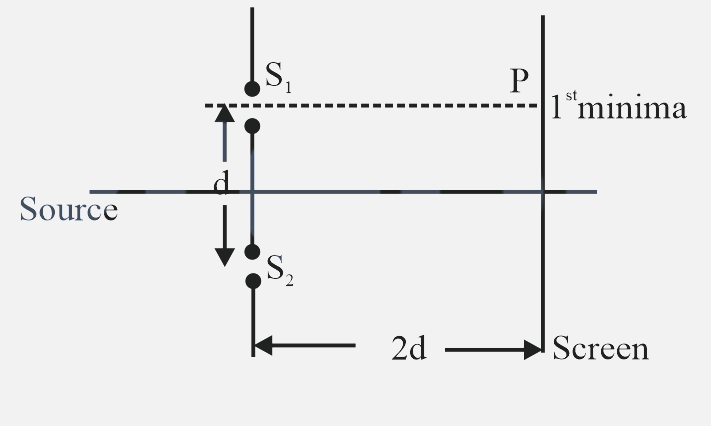
Consider a Young's double slit experiment as shown in the figure. What should be the slit separation \( d \) in terms of the wavelength \( \lambda \) such that the first minima occurs directly in front of the slit \( \left(S_1\right) \)?

Page 1 of 6
Need Expert Advice?