All Exams Test series for 1 year @ ₹349 only

JEE Main 2019 Question Paper with Solutions (09-Apr-2019) (Shift 2); Download PDF

JEE Main 2019 Question Paper with Solutions for Apr 9, 2019 Shift 2 is available here for PDF download and can also be attempted in a test format for practice. JEE Main Paper 1 (B.E./B.Tech) is conducted in CBT mode and includes Physics, Chemistry, and Mathematics.

Free
JEE Main 2019 Question Paper (09-Apr-2019) (Shift 2)
180 Minutes
90 Questions
360 Marks
English
Showing 1 - 5 of 30 questions
Page 1 of 6

Q1.

Two cars A and B are moving away from each other in opposite directions. Both the cars are moving with a speed of \(20  \mathrm{m} \, \mathrm{s}^{-1}\) with respect to the ground. If an observer in car A detects a frequency of \(2000  \mathrm{Hz}\) of the sound coming from car B, what is the natural frequency of the sound source in car B? 
(speed of sound in air \(= 340  \mathrm{m} \, \mathrm{s}^{-1}\))

Q2.

A particle of mass $m$ is moving with speed $2v$ and collides with a mass $2m$ moving with speed $v$ in the same direction. After the collision, the first mass is stopped completely while the second one splits into two particles each of mass $m$, which move at an angle $45^{\circ}$ with respect to the original direction. The speed of each of the moving particles will be

Q3.

A convex lens of focal length $20\ \mathrm{cm}$ produces images of the same magnification 2 when an object is kept at two distances $x_1$ and $x_2$ ($x_1 > x_2$) from the lens. The ratio of $x_1$ and $x_2$ is:

Q4.

The parallel combination of two air-filled parallel plate capacitors of capacitance $C$ and $nC$ is connected to a battery of voltage $V$. When the capacitors are fully charged, the battery is removed, and after that, a dielectric material of dielectric constant $K$ is placed between the two plates of the first capacitor. The new potential difference of the combined system is:

Q5.

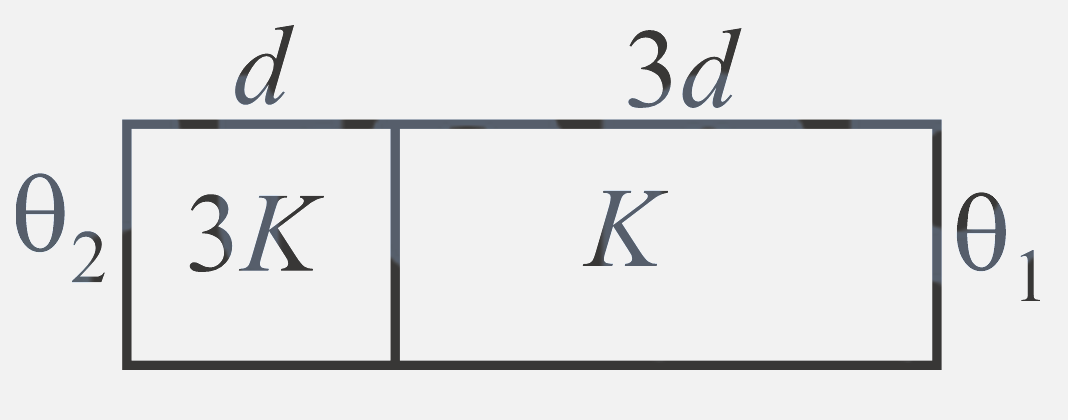
Two materials having coefficients of thermal conductivity $3K$ and $K$ and thickness $d$ and $3d$ respectively, are joined to form a slab as shown in the figure. The temperatures of the outer surfaces are ${\theta}_{2}$ and ${\theta}_{1}$ respectively, $\left({\theta}_{2} > {\theta}_{1}\right)$. The temperature at the interface is

Page 1 of 6
Need Expert Advice?