JEE Main 2019 Question Paper with Solutions (08-Apr-2019) (Shift 2); Download PDF
JEE Main 2019 Question Paper with Solutions for Apr 8, 2019 Shift 2 is available here for PDF download and can also be attempted in a test format for practice. JEE Main Paper 1 (B.E./B.Tech) is conducted in CBT mode and includes Physics, Chemistry, and Mathematics.
JEE Main 2019 Question Paper (08-Apr-2019) (Shift 2)
Q1.
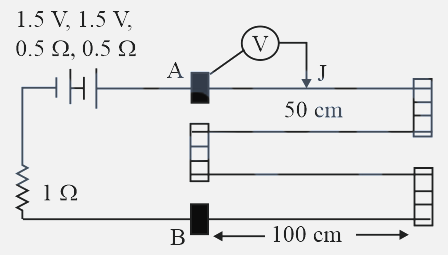
In the circuit shown, a four-wire potentiometer is made of a $400\mathrm{cm}$ long wire, which extends between $\mathrm{A}$ and $\mathrm{B}$. The resistance per unit length of the potentiometer wire is $r = 0.01\Omega/\mathrm{cm}$. If an ideal voltmeter is connected as shown with jockey $\mathrm{J}$ at $50\mathrm{cm}$ from end $\mathrm{A}$, the expected reading of the voltmeter will be:
Q2.
Two very long, straight, and insulated wires are kept at $90^\circ$ angle from each other in the $xy$ plane as shown in the figure.
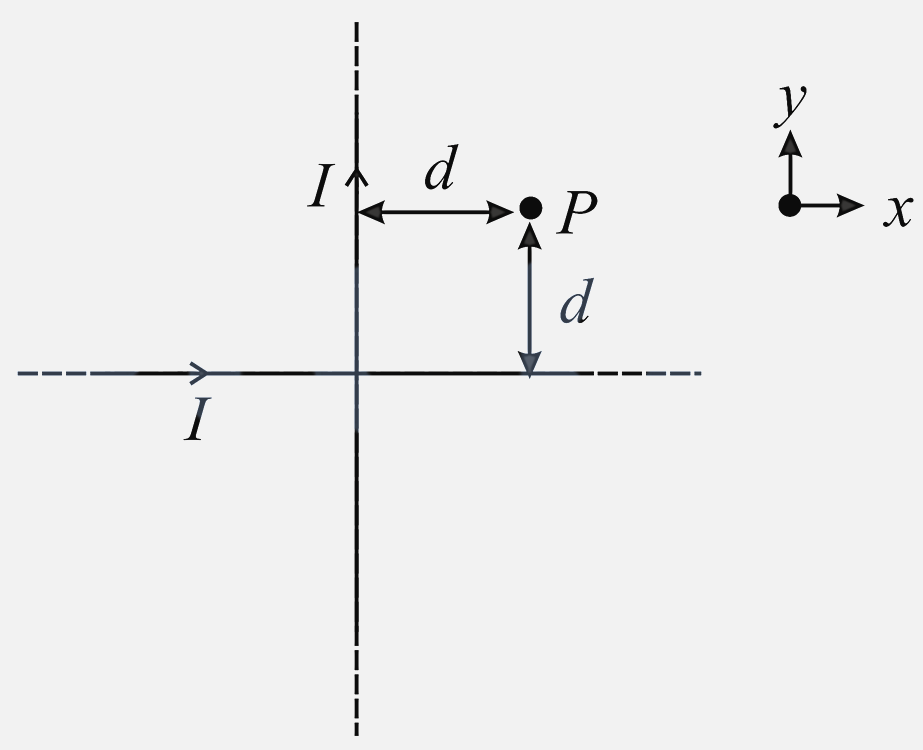
These wires carry currents of equal magnitude $I$, whose directions are shown in the figure. The net magnetic field at point $P$ will be:
Q3.
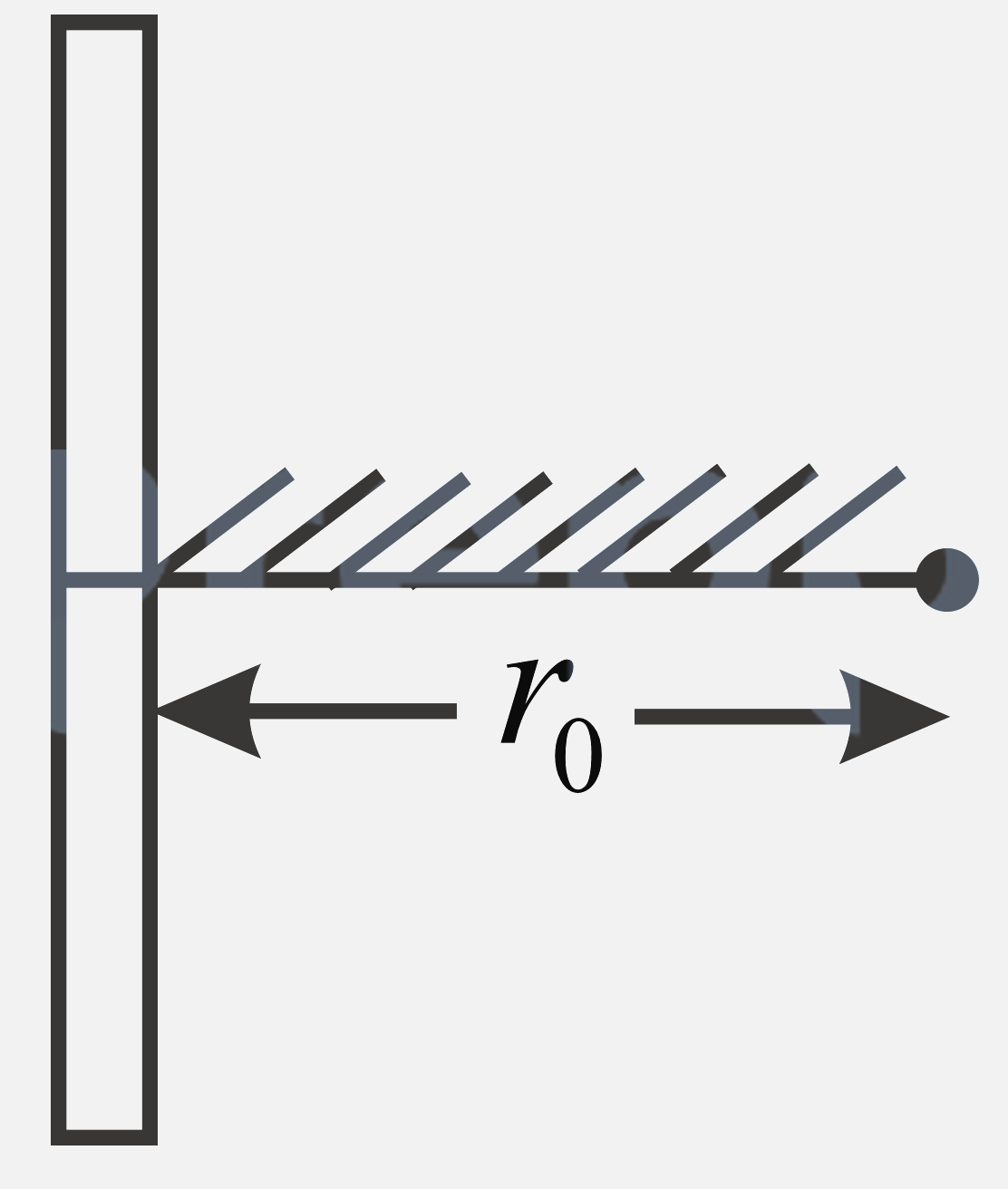
A positive point charge is released from rest at a distance $r_0$ from a positive line charge with uniform charge density. The speed $\left(v\right)$ of the point charge, as a function of instantaneous distance $r$ from the line charge, is proportional to