
Studying for Global Exams in Europe? Here's How to Make Your Study Commute Work For You
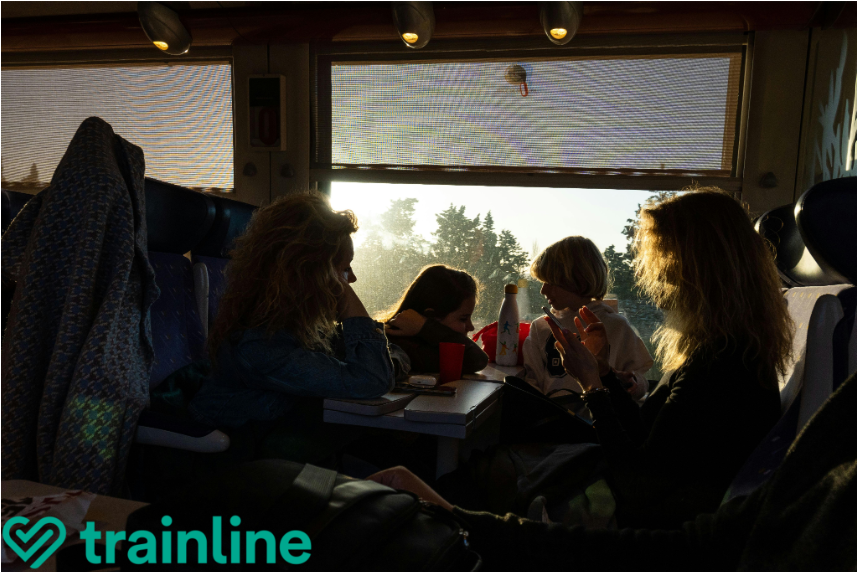
It's 7:15 a.m. on a Tuesday in late April. Outside the window of a regional train pulling out of a suburban station somewhere in the south of France, the early morning light is catching the rooftops. Inside the carriage, a seventeen-year-old has her phone propped against her bag, earbuds in, running through a set of Biology flashcards for the third time this week. Her exam is on Thursday. The journey takes forty-two minutes. She's used every one of them.
This scene — or some version of it — is playing out every weekday morning across France, Spain, Italy, the UK, and beyond. For tens of thousands of IB students in Europe, the daily rail commute to school and to exam centres is not dead time. It is, for the organised and intentional student, some of the most productive time in the entire revision calendar.
But getting the most out of your study commute starts before you board the train. It starts with having the right ticket, at the right price, on a service you can rely on. It starts with Trainline.
The Geography of IB Education in Europe
To understand why the study commute matters so much for IB students specifically, it helps to understand the geography of IB education across Europe.
Unlike national curriculum qualifications delivered in most local secondary schools, the International Baccalaureate is offered by a smaller and more specifically distributed network of authorised schools. In France, the majority of IB World Schools are concentrated in Paris and a handful of larger cities — Lyon, Bordeaux, Toulouse, Strasbourg. Students from surrounding towns and suburban areas who want to study the IB diploma travel into those cities every day. The same pattern holds in Spain, where IB schools cluster in Madrid, Barcelona, Seville, and Valencia. In Italy, Rome and Milan are the centres of IB provision. In the UK, IB schools are distributed across London, Edinburgh, Bristol, and other major cities, but are less common in smaller towns.
What this means in practice is that a significant proportion of IB students across Europe are already commuters before exam season even begins. The daily train journey to school — across a metropolitan area, or from a smaller town to a larger city — is part of their academic life in a way that students at local schools simply don't experience.
And during the four-week May examination window, that commute takes on a new significance. You're not travelling to school for a normal day of lessons. You're travelling to sit a paper that contributes to a globally recognised qualification. Every minute of that journey is a minute you can use — or waste.
What the 2026 IB Zone Timing Changes Mean for Your Commute
The May 2026 IB examination session introduced updated zone timing protocols that made punctual arrival at exam centres more critical than ever before.
Under the revised rules, students in Zone B — covering Europe, the Middle East, and Africa — were assigned specific arrival windows for each examination sitting. The flexibility that had previously existed around when students could enter the hall was significantly reduced. Arrive after the window closes, and you may not be admitted. Arrive at the last minute without time to settle, and you're starting a high-stakes exam in an anxious, rushed state that directly affects your performance.
The practical consequence is that the margin for transport disruption has narrowed considerably. A train running eight minutes late because of a signalling issue on the line no longer means you arrive slightly frazzled — it means you may miss your window entirely. A bus caught in morning traffic that would previously have been an inconvenience is now a genuine risk to your exam.
This is precisely why Trainline's live departure boards and real-time delay alerts are not just a convenience for exam-season commuters — they are a material part of exam preparation. Knowing in real time that your usual 7:42 service is running six minutes late, and being able to identify the 7:35 backup service on Trainline before you've even left the house, is the kind of operational intelligence that keeps a Thursday Biology exam firmly on track.

The Case for Rail Over Every Other Commute Option
Let's address the alternatives honestly, because the choice of how to commute to school and exam centres during the IB session is not trivial.
Driving or being driven is the default for many families, and for shorter distances it's often perfectly workable. But for students commuting from smaller towns into major cities for their exams — Paris, Madrid, Rome, London — driving introduces a set of variables that rail doesn't. City-centre congestion. Parking scarcity and cost near exam venues. The cognitive load on a parent who has to navigate unfamiliar streets while simultaneously trying to keep a nervous student calm. And crucially, the unpredictability. A journey that takes thirty-five minutes at 7 p.m. on a Sunday might take seventy minutes at 8 a.m. on a Wednesday. Rail timetables don't have that variability.
Buses are subject to the same congestion issues as cars, with less flexibility. If a city bus is caught in standstill traffic two kilometres from your exam venue fifteen minutes before the doors close, your options are limited. You can't ask the bus to take a different route.
Trains run on fixed infrastructure. The timetable is known in advance. The journey time is reliable. And with Trainline's live updates and delay notifications, any deviation from that timetable comes to you as information you can act on, rather than a surprise you discover at the platform.
For the exam commute specifically, rail is not just the most comfortable option. It is the most risk-managed option available.
How to Book Smarter During the Four-Week Exam Window
Here's where the financial dimension of exam-season commuting becomes genuinely important, and where Trainline delivers measurable value to IB families.
The May 2026 IB examination session ran from 25 April to 20 May — four weeks during which students were making regular journeys to exam centres, sometimes multiple times per week. If each of those journeys is purchased as a separate day ticket at walk-up prices, the cumulative cost over four weeks is significant. Most families, if they stop to calculate it, are surprised by how much the exam commute actually costs when purchased on an ad-hoc basis.
Trainline gives you better options.
Advance booking locks in cheaper fares. On routes served by national rail operators — across the UK and across major European networks — advance fares are substantially cheaper than same-day walk-up prices on the same service. If you know your exam timetable — and by mid-April, you do — you can book every journey for the entire four-week session in a single Trainline session. The advance fares you secure will, across a month of travel, save a meaningful amount compared to buying each ticket on the day.
Weekly and monthly travel passes where available. On certain routes, particularly commuter rail services within major metropolitan areas, weekly or monthly season tickets offer the cheapest per-journey cost for regular travel. Trainline helps you identify whether a pass is available on your route and compare it against the cost of daily bookings. For a student making five or more journeys per week to an exam centre in a city they commute into regularly, a weekly pass booked through Trainline is almost always the cheapest approach.
The 16-25 Railcard for UK-based students. If you're an IB student commuting to exam centres within the UK, a 16-25 Railcard integrated into your Trainline account gives you thirty percent off most fares automatically. Over a four-week exam session with multiple journeys per week, that discount compounds significantly. The railcard costs thirty pounds for the year and pays for itself within a handful of journeys at exam-season frequency.
Price calendar for flexible journey dates. For exam journeys where you have some flexibility around the time of travel — a later morning exam that gives you choice between an 8 a.m. and a 9 a.m. service, for instance — Trainline's price calendar shows fare variations across different departure times, helping you identify the cheapest option that still gets you there with adequate buffer time.
Turning Your Commute Into a Revision Session
Now let's talk about what actually happens on the train — because the study commute, handled well, is one of the most underused revision assets in the IB student's toolkit.
The average IB student in Europe spends between thirty minutes and an hour on a one-way commute to school or exam centre. Over the four-week exam session, with journeys in both directions, that represents somewhere between twenty and forty hours of potential revision time. That is not nothing. That is roughly the equivalent of an entire week of school lessons.
The question is not whether you can revise on a train. You obviously can. The question is how to make that revision as effective as possible in a moving, occasionally noisy, non-desk environment.
Flashcards are the commute format of choice. Whether physical cards or a digital app like Anki or Quizlet, flashcards are perfectly adapted to the commute context. They require no desk, no sustained concentration on a single text, and no writing. They work in short bursts — a five-minute run through a Biology definition set, a ten-minute review of History dates and events. The spaced repetition that makes flashcard revision so effective is naturally supported by the commute structure: you review the same material on Monday morning, Wednesday morning, and Friday morning, and the gaps between reviews are automatically managed.
Audio notes and recorded summaries. Many IB students underuse audio as a revision medium. Recording yourself summarising a topic — the causes of the First World War, the mechanism of enzyme inhibition, the key arguments in your History essay — and playing it back during your commute is a remarkably efficient way to consolidate material. You can do it with your eyes closed. You can do it standing in a crowded carriage. And the act of recording the summary is itself a valuable revision exercise that forces you to retrieve and organise information.
Light reading of notes, not heavy problem-solving. The commute is not the place for attempting unseen exam questions under timed conditions or working through complex mathematical proofs. The environment doesn't support that level of focused cognitive work. But reviewing structured notes — reading through a topic summary, re-reading your own essay annotations, checking key vocabulary for your Language B exam — is well-suited to a train journey and meaningfully reinforces material that more intensive desk-based revision has already established.
The return journey as debrief. On exam days specifically, the journey home has a distinct function. You've just sat a paper. Your mind is running over answers, second-guessing choices, relieved or anxious about particular questions. The conventional wisdom is to avoid post-exam analysis — looking up answers, comparing with friends, dwelling on what you wrote — because it produces anxiety without changing anything. The return train journey is actually a good environment for deliberate mental reset: put on music, watch something light, let your mind decompress. You have another exam coming. The best thing you can do for it is arrive at tomorrow's revision session mentally rested rather than still processing today's paper.
For Families Travelling Across European Cities During Exam Season
Exam season is not just a student experience. For the parents and families of IB students — particularly those whose children attend international schools in cities far from home — the May examination window involves significant travel of their own.
It is more common than most people realise for families to travel to be with their children during IB exam season. A student at a boarding school in Switzerland whose family is based in Paris. A student at an international school in London whose parents fly in from Madrid for the final exam week. A student in Rome whose grandparents travel from Milan to be nearby during the most stressful academic period of their grandchild's life so far. These are real patterns of family movement, and they happen every year during the IB exam window.
For inter-city family travel across Europe during this period, train is the dominant practical choice — and Trainline is the platform that makes it manageable.
Paris to London via Eurostar is two hours fifteen minutes and bookable through Trainline with advance fares available weeks in advance. A family wanting to be in London for the last week of their child's IB exams can plan and book the entire trip — outward journey, return journey, times chosen around the exam schedule — in a single Trainline session.
Milan to Rome on Trenitalia Frecciarossa high-speed services takes under three hours and is covered by Trainline's European booking. For Italian families travelling between cities to support a student, this is the obvious choice.
Barcelona to Madrid by AVE high-speed rail takes two and a half hours, and Madrid to Paris — for families needing to cross the border — connects via TGV through the Pyrenees. Again, Trainline covers the full cross-border booking without requiring separate accounts with different national operators.
The practical advantage of Trainline for travelling families is consistency. Rather than navigating SNCF, Trenitalia, Renfe, and Eurostar separately — each with its own interface, its own booking flow, and its own account requirements — one Trainline account covers the whole of it. For a parent managing a demanding schedule of their own who needs to plan a trip to support their child during exams, that simplicity is genuinely valuable.
Managing Disruption: What to Do When Things Go Wrong
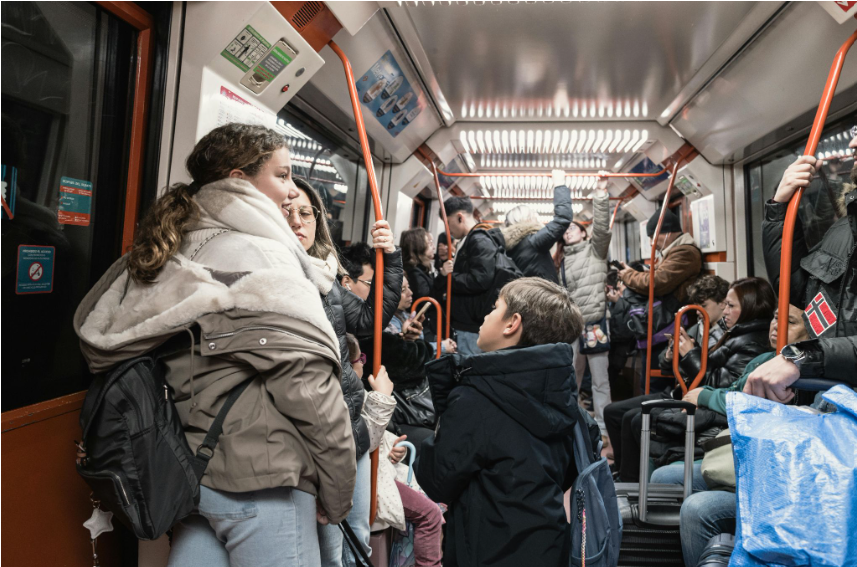
Train travel is reliable, but it is not infallible. Strikes happen — in France particularly, rail industrial action has been a recurring feature of recent years. Engineering works occasionally close routes or cause delays. Extreme weather can affect services. And for an IB student with a 9 a.m. exam and an 8:10 train that is suddenly showing a forty-minute delay, the response in the next ten minutes matters.
Here is a practical protocol for managing transport disruption on exam days, supported by Trainline.
Check Trainline before you leave the house. This is the single most important habit to build during exam season. Before you get dressed, before you eat breakfast, open Trainline and check your booked service. If there's a disruption, you find out with time to act rather than at the platform with none.
Have the backup service already identified. For every exam journey, know your backup train in advance. If your planned 7:42 is the right departure for comfortable arrival, know that the 7:20 gets you there earlier and identify it on Trainline before the exam week begins. If disruption strikes, you're not searching for alternatives under pressure — you already know what to do.
Trainline's delay alerts come to you. You don't have to actively monitor the departure board. Trainline pushes real-time notifications to your phone when a booked service is delayed or cancelled. This means that even if you're in the middle of a final flashcard review and not watching your phone, the information finds you in time to act on it.
Know your exam venue's disruption policy. Most IB exam centres have protocols for students who are delayed by genuine, documented transport disruption. If you arrive late due to a rail delay that you can evidence — and Trainline's delay records can serve as documentation — contact the exam centre immediately rather than simply not appearing. Many centres have provisions for these situations. But you need to communicate promptly and have evidence of the disruption.
On days of known disruption risk, travel earlier. If there's a strike announced for the date of a major exam, or engineering works that are reducing service frequency on your route, book the earlier train through Trainline and adjust your morning accordingly. An extra forty-five minutes at the exam venue is not a problem. Missing the exam is.
A Week-by-Week Guide to the Exam Commute
The four-week IB exam session has a rhythm to it, and your approach to the study commute should shift as the session progresses.
Week One: Establish the routine
The first week of exams is when habits form. This is the week to establish your commute practice — the flashcard deck you'll use, the audio notes you'll listen to, the exact time you need to leave the house to catch your preferred service. Book your Trainline tickets for the full four weeks if you haven't already. Identify your backup trains. Download your tickets for offline access.
Week Two: Consolidation
By the second week, the exam routine is running. Your study commute is working. The question now is whether you're using the return journeys well — not to post-analyse your just-completed paper, but to preview the next subject. A light read-through of your summary notes for tomorrow's exam on the journey home from today's paper is one of the most efficient revision strategies available during a compressed exam window.
Week Three: Managing fatigue
Week three is where tiredness sets in. You've been sitting exams, maintaining revision, managing the emotional weight of performance anxiety, and commuting daily for nearly three weeks. The study commute in week three should be lighter in cognitive load than in week one. Audio revision over active flashcard work. Review of material you know well rather than cramming material you don't. And sleep on the train, guilt-free, if your body needs it. A rested brain will outperform a tired one in the exam hall regardless of what you managed to review on the journey.
Week Four: The final stretch
The last week of the IB session typically contains some of the most demanding papers — History Paper Three, the final Language exams, Sciences. Your commute this week is about calm reinforcement rather than new learning. Nothing you learn in the final forty-minute train journey before a History exam is going to move the needle on your grade. What will move the needle is arriving composed, focused, and physically present. Use the journey for whatever mental state management works for you — music, light review, deep breathing, conversation with a friend. Arrive ready.
![trailine]()



Why Trainline Is the Right Choice for Exam-Season Commuters
Trainline is not simply a ticket-booking app. For IB students navigating the exam commute across Europe, it is a logistics platform that reduces friction at every point in the journey — from advance booking and fare comparison, to real-time delay alerts and mobile ticketing that works offline.
The breadth of coverage matters. Whether you're an IB student in Birmingham taking the bus-rail-bus chain to an exam centre in the city, a student in Lyon catching a regional TER service into central Paris, or a student in Barcelona navigating Cercanías commuter rail to an exam venue on the other side of the city — Trainline covers all of it. One account, one app, one consistent experience regardless of which country's rail network you're using or which operator is running the service.
The advance booking capability matters. The difference between the cost of a month's worth of advance-booked exam commute tickets and the same journeys purchased as same-day walk-up fares is, for most routes, substantial. For families already managing the financial weight of IB school fees, exam registration costs, and the general expense of international education, that saving is real money.
And the peace of mind matters. In a period where stress is already running high and every variable that can be controlled should be controlled, knowing that your travel is sorted — booked, confirmed, downloadable to your phone, with real-time alerts if anything changes — removes one significant source of background anxiety. Which is, ultimately, the point.
Your exams deserve your full attention. Trainline handles the rest.
Final Thought: The Train Knows Where You're Going
There is something quietly clarifying about a train journey taken with purpose. You board. You're moving. The decisions about route and timing are already made. The only question remaining is what you do with the time.
For IB students making the study commute across Europe in May 2026 and beyond, that time is not nothing. It is a genuine asset — forty minutes of focused revision, a debrief conversation with a friend, a mental reset between two difficult exam days. The train, in that sense, is part of the preparation. Not incidental to it.
Book your exam commute on Trainline. Book it in advance. Apply your railcard discount. Set up delay alerts. Download your ticket.
Then board the train, put in your earbuds, open your flashcards, and use every minute.
Plan your study commute across the UK and Europe — book in advance with Trainline, save on every journey, and arrive at every exam ready to perform.
Download the PREPP App and attempt FREE Nursing Mock Tests and get complete study material!


Comments