
IB Exam Season in Europe: How to Plan Your Travel to the Exam Centre Without the Stress

The alarm goes off at 6 a.m. Your IB exam starts at 9. You've spent the last three months buried in past papers, revision notes, and colour-coded flashcards. You know the syllabus. You've done the work. But as you lie there in the dark, there's a low-level hum of anxiety that has nothing to do with oxidation states or essay structure.
It's the journey.
How long will it take? Is the train on time? Did you actually book a ticket, or did you just mean to? What happens if there are delays?
For tens of thousands of IB students across Europe, the commute to the exam centre is one of the most overlooked sources of exam-season stress. It doesn't get talked about in study guides. It doesn't feature in the revision timetables teachers hand out in February. And yet, on the day, it can be the thing that throws everything off.
The good news is that it's also the easiest part of exam season to fix. With a bit of planning — and Trainline — you can make the journey to your exam centre the one thing you genuinely don't have to worry about.
Understanding the Scale of IB Exam Season in Europe
Before we get into the practical detail, it helps to understand just how significant the IB exam period is across Europe, and why transport planning matters more than most people realise.
The IB May 2026 examination session ran from 25 April to 20 May — a four-week window spread across multiple subjects, multiple time slots, and in many cases, multiple different exam venues. This isn't like a school test where you walk down the corridor at 10 a.m. and walk back to your classroom by noon. The International Baccalaureate is a globally administered qualification with centralised exam centres, strict protocols, and absolutely no tolerance for late arrivals.
During those four weeks, students across France, Italy, Spain, the UK, Germany, the Netherlands, Switzerland, and beyond were making that journey repeatedly. Some students had exams on back-to-back days. Some had exams in the morning and the afternoon. Every single one of those journeys required getting to a specific place, at a specific time, with the right documents and the right mindset.
That's a commute. And just like a work commute, the less you have to think about it, the better everything else goes.
Why IB Students Often Travel Further Than You'd Expect
Here's something that catches a lot of families off guard: IB schools are not uniformly distributed across cities and towns. Unlike the standard national curriculum, which is delivered in most local secondary schools, the International Baccalaureate is offered by a smaller number of authorised schools — often independent schools, international schools, or specialist state schools with specific entry criteria.
What that means in practice is that many IB students are already travelling significant distances to attend school in the first place. And for exams, the venue isn't always even the school itself. Some exam centres are separate facilities. Some schools use hired halls or partner venues for specific subjects. Some students find themselves travelling to an exam centre they've never visited before.
In a city like London, that might mean crossing three or four tube zones. In Paris, it might mean navigating the RER across multiple arrondissements. In Madrid or Rome, it might mean figuring out a combination of metro and walking through an unfamiliar neighbourhood, on a weekday morning, with an exam in two hours.
For younger IB students — particularly those in the first year of the Diploma Programme — this kind of travel can feel genuinely daunting. And for parents trying to support them, the uncertainty about routes, timings, and ticketing adds its own layer of stress to what is already a high-pressure period.
Train travel, and specifically booking through Trainline, is the antidote to most of that uncertainty.
The New 2026 IB Rule That Changes the Timing Calculation
If you weren't already thinking carefully about your exam day timing, a new IB regulation introduced for the 2026 session makes it non-negotiable.
Under the updated rules, students are now required to remain in the examination hall until all candidates in their zone have completed their papers. This is a significant change from previous years, when students could leave quietly once they had finished their own work. The new rule is designed to maintain examination integrity and prevent any sharing of content between students who finish early and those still writing.
The practical consequence for travel planning is this: you now need to account not just for getting to the exam on time, but for a potentially extended stay at the venue on the way out. If you've arranged for someone to collect you, they need to know the session could run longer than the nominal exam length. If you're catching a connecting train home, you need to build in more buffer than you might have in previous years.
This makes advance planning even more important. Knowing your route, having your return journey loosely mapped out, and using Trainline to check connections in real time means you're not left scrambling when you finally walk out of the hall at a time you didn't quite anticipate.

Why Train Travel Is the Right Choice for Exam Day
Let's talk about the transport options and why rail consistently comes out on top for exam day journeys in Europe.
Driving seems convenient until you factor in the reality of arriving at a city-centre exam venue on a weekday morning. Parking is often limited or non-existent near schools and exam halls. Road traffic in major cities is unpredictable in a way that train schedules simply aren't. And the mental load of navigating traffic while trying to stay calm before a major exam is exactly the kind of thing you want to avoid. Parents who drive students to exam centres often report higher stress levels — for themselves and the student — compared to those who use rail.
Buses and coaches are better than driving, but they're subject to the same congestion issues. Bus lanes help in some cities, but a city bus caught in standstill traffic on a major arterial road thirty minutes before your exam starts is a specific kind of nightmare. Timetables are less reliable, and in many European cities, bus networks are less extensive than rail.
Ride-sharing apps like Uber and Bolt have surge pricing. On weekday mornings during busy commuting periods, prices can spike significantly. There's also the issue of driver availability and cancellations, which add uncertainty to a journey where certainty is everything.
Walking and cycling work brilliantly if you're close enough, and if you've planned the route in advance. But for the significant proportion of IB students who live far from their exam centre, these aren't realistic options for the main journey.
Train travel eliminates most of these variables. Trains run on fixed timetables. Tickets booked in advance through Trainline lock in your seat and your fare. You know which platform you're leaving from, what time you arrive, and where the station is in relation to the venue. You can sit, review your notes, eat something, or simply breathe — rather than white-knuckling it through city traffic.
For parents travelling with their children to exam centres in London, Paris, Madrid, and Rome, rail is consistently described as the safest and most predictable choice. It's not just about speed. It's about arriving in the right mental state.
How Trainline Takes the Friction Out of Booking
Trainline is Europe's leading independent rail booking platform, covering train and coach travel across the UK and more than 45 countries in Europe. For IB students and their families, that breadth of coverage is one of its most valuable features during exam season.
Whether you're booking a single journey across London on the Elizabeth line, a regional train from a smaller French city to Paris for an exam centre there, or a connection between cities in Spain or Italy, Trainline handles it in one place. You don't need to know which rail operator runs a particular route, register with multiple national rail websites, or navigate interfaces in languages you might not be fluent in. Trainline aggregates it all and presents your options clearly.
Here's what the booking experience looks like in practice during exam season:
Search by destination, not operator. Enter where you're travelling from and your exam centre's nearest station. Trainline returns all available services, sorted by departure time, journey duration, and price. You can immediately see whether an advance ticket or off-peak fare saves you money compared to an anytime ticket.
Book in advance for the cheapest fares. Advance tickets on many European rail routes are significantly cheaper than walk-up fares. Trainline surfaces these automatically. For a family with a student sitting ten or twelve exams across a four-week period, those savings compound meaningfully. Booking the night before each exam — rather than on the morning — is one of the simplest financial decisions of the exam season.
Railcard discounts applied automatically. If you hold a 16-25 Railcard, a Family & Friends Railcard, or another eligible railcard, Trainline applies the discount during the booking process. You don't need to remember to add it manually or show a separate card at the barrier (though you should still carry it for inspection).
Mobile tickets, no printing required. Your ticket lives in the Trainline app. It works offline. You don't need Wi-Fi at the station, and you don't need to queue at a ticket machine at 7:45 a.m. when every other commuter in the city is trying to do the same thing. You tap through the barrier and you're on the platform.
Real-time updates and disruption alerts. If your service is delayed or a platform changes, Trainline pushes a notification. You find out before you're already at the wrong end of the station. This kind of real-time visibility is particularly valuable on exam mornings when your attention should be on the exam, not on monitoring the departure board.
City-by-City: What IB Students Should Know About Rail in Europe's Major Cities
Every city is different, and so is its rail network. Here's a practical overview for the cities where IB students are most concentrated.
London
London has one of the most extensive urban rail networks in the world, but it can feel overwhelming if you're not familiar with it. The key distinction for exam-day travel is between the Underground (Tube), the Overground, the Elizabeth line, and National Rail services. Trainline covers all of them.
For students travelling into central London from outer zones, the Elizabeth line is often the fastest option — it's direct, it's frequent, and it avoids some of the congestion that slows down other lines during peak hours. Overground services are reliable for cross-city journeys that don't go through the centre.
Book your Trainline ticket the night before. Download it to your phone. Add five minutes to whatever Google Maps tells you the journey takes — platforms at major stations like Paddington, King's Cross, and Victoria are large and can take time to navigate if you don't know them well.
Paris
Paris's RER network is the backbone of exam-day travel for students coming from suburbs and satellite towns. The RER A, B, C, D, and E lines connect the outer zones to central Paris quickly and directly, and they're generally more reliable than surface buses for punctuality.
The Metro covers journeys within Paris itself. If your exam centre is in the city, identify the nearest Metro station in advance and note the line number and direction. Paris Metro maps are available in the Trainline app.
One Paris-specific note: stations can be large and confusing if you don't know them. Châtelet–Les Halles, for instance, is one of the largest underground stations in the world. If you're connecting there, allow more time than you think you need and download an offline map.
Madrid
Madrid's Cercanías commuter rail network connects the greater metropolitan area to the city centre and is the best option for students travelling from towns and suburbs around the capital. Within the city, the Metro is fast and frequent.
Trainline covers intercity rail connections across Spain, which is particularly relevant for students at international schools in cities like Seville, Valencia, or Bilbao who may need to travel to a designated exam centre.
The key advice for Madrid: avoid relying on ride-sharing during morning rush hour. The city's traffic during peak commuting times is severe, and the Metro will get you there faster and more reliably.
Rome
Rome's rail infrastructure is more limited within the city itself compared to London or Paris, but the Trenitalia network covers intercity and regional connections efficiently. For students travelling from outside Rome to a city-centre exam centre, regional trains booked through Trainline are the most reliable choice.
Within Rome, the Metro has only two main lines (A and B), so journey planning is more dependent on bus connections for the final leg of a trip. Build in extra time and use the Trainline app's journey planner to map the full route from your origin station to the exam venue.
Other European Cities
For IB students in cities like Amsterdam, Brussels, Geneva, Frankfurt, or Barcelona, Trainline's European coverage means you can book the same way regardless of which country's rail network you're using. The interface and booking flow are consistent. Your ticket is in the same app. That consistency matters when you're already managing the cognitive load of exam season.
The Psychology of Exam-Day Travel
There's a dimension to this that doesn't get discussed enough: the psychological impact of a stressful journey on exam performance.
Research on cognitive load and test performance consistently shows that students perform better when they arrive at an exam venue in a calm, focused state — rather than flustered, rushed, or anxious. This sounds obvious, but its implications for travel planning are often ignored.
A journey that goes wrong — a missed train, a cancelled service, a wrong platform, a fare machine that won't accept your card — doesn't just cost you time. It floods your system with cortisol at exactly the moment you need to be settling into focused recall. The first twenty minutes of an exam, when you're reading the questions and planning your approach, are disproportionately important to your final result. Walking in five minutes late, heart pounding, is not the way to begin.
Booking your train on Trainline the night before is a small act with an outsized psychological return. You've removed one uncertainty from the morning. You know what time you're leaving, you know what time you arrive, and you know your ticket is in your phone. That's one less thing your brain is running in the background at 7 a.m.
The students who walk into the exam hall with that particular kind of quiet readiness — settled, present, focused — are often the ones who've sorted their logistics the night before. The revision is done. The journey is handled. There's nothing left to worry about except the exam itself. And that's exactly where your attention should be.
A Practical Guide for Parents Supporting IB Students Through Exam Season
Parents carry a significant portion of the logistical weight during IB exam season, particularly for students in the earlier years of the Diploma Programme who may not have much experience navigating city transit independently.
Here's a practical framework for parents planning transport over the exam period.
Week before exams begin: Sit down with your student and map out every exam date, time, and location. Some exams may be at different venues. Note which ones require earlier departures, and which have tighter timing due to connections.
Use Trainline to search all journeys in advance. You don't have to book every ticket weeks ahead, but knowing the route, the best departure time, and the approximate fare means you're not scrambling on the morning. For advance fares on intercity routes, earlier booking genuinely saves money — sometimes substantially.
Identify a primary train and a backup. For each exam, have two trains in mind: the one you plan to take, and an earlier one that gets you there with thirty minutes to spare. If anything goes wrong with the first, you have a safety net. Book both if the cost is manageable, or at minimum know the earlier train's departure time so you can make a quick decision on the day.
Download the Trainline app and make sure your student knows how to use it. For students who are travelling independently, this is essential. Show them how to access their ticket, how to read the journey information, and how to check for real-time updates. Run through it once on a non-exam day so it's not new on the morning of a paper.
Build in venue-finding time. Arriving at a station is not the same as arriving at the exam room. Factor in the walk from the station to the venue, finding the right entrance, signing in, and getting settled. An extra fifteen minutes here is never wasted.
Stay calm during the journey. Students pick up on parental anxiety. If you're travelling with your child to the exam centre, treat the journey as a transition — a deliberate shift from preparation mode to performance mode. Talk about something other than the exam. Keep the energy calm and even. Trainline having handled the booking means there's genuinely nothing to stress about on the journey itself.
Exam Season Is Four Weeks Long — Think in Phases, Not Just Days
One of the mistakes families make with IB exam logistics is treating each exam day in isolation rather than thinking about the full four-week arc.
The first week of exams tends to go smoothly because everyone has prepared. By week three, fatigue sets in. Students are tired. Revision for upcoming papers is competing with recovery from previous ones. And the last thing a tired, mentally depleted student needs on a week-three exam morning is a transport problem that could have been avoided.
Trainline's ability to book in advance means you can front-load the planning. Spend an hour in late April, before the session begins, mapping out the full exam schedule and booking the key journeys. Lock in the advance fares. Download the tickets. Then, during the exam period itself, the transport is simply handled — one fewer thing competing for your attention when your attention is already stretched thin.
For families with multiple children sitting exams, or with students at different schools, this consolidated planning approach is even more valuable. Trainline's account system allows you to manage multiple bookings in one place, see upcoming journeys clearly, and make changes if exam schedules shift.
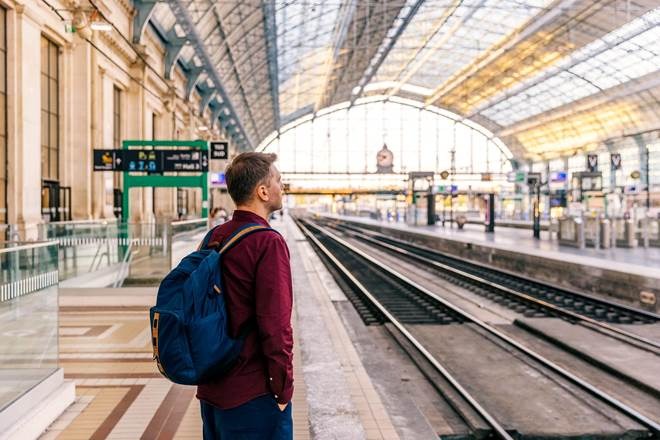
The Night Before: A Simple Routine That Makes the Morning Easier
The night before an exam is a surprisingly important moment in the logistics chain. Here's a simple routine that removes friction from the morning:
Check your exam start time and venue one more time. Mistakes happen. Venues change. Confirm both.
Open Trainline and book tomorrow's train if you haven't already. Even if it's 11 p.m., booking now means your ticket is ready in the app. Check the advance fare — it will almost always be cheaper than a walk-up fare at the station in the morning.
Download your ticket for offline access. Station Wi-Fi is unreliable. Mobile data at busy commuter stations can be slow. Having the ticket downloaded means it's there regardless.
Set two alarms. One for your actual wake-up time, one as a reminder to leave the house. Calculate your departure time backwards from your exam start: exam at 9 a.m., allow thirty minutes at the venue, twenty-minute walk from the station, forty-minute train journey, fifteen minutes to get to the station. You need to leave the house by 7:05. Set the alarm for 7:00, not 7:10.
Put everything you need by the door. ID, student card, pencil case, water, snack, phone charged. And your Trainline ticket already downloaded.
Stop revising. Seriously. The marginal return on revision at 11 p.m. the night before an exam is close to zero. Sleep, and arrive rested. That's the better exam strategy.
One App, Across the Whole of Europe
Perhaps the most quietly powerful thing about Trainline for IB families is the breadth of its coverage.
The IB is a genuinely international qualification. Students sit it in international schools across dozens of European countries. Families move. Students study abroad. Exam centres are sometimes in cities students don't know well. The idea that you'd need to research local rail booking websites, register with national rail operators in multiple languages, and navigate unfamiliar interfaces for each country's system is exhausting.
Trainline is one app, one account, one booking flow — whether you're catching the 7:42 from Bristol Parkway to London Paddington, the 8:15 RER B from Charles de Gaulle to central Paris, or a regional Trenitalia service from outside Rome to Termini. The tickets are in the same place. The real-time updates come through the same system. The customer support is consistent.
For the student sitting exams in London this year and planning to study at a university in another country next year, Trainline grows with you. It's not a tool for exam season and nothing else. It's how a generation of young Europeans are learning to travel independently, efficiently, and without the stress that used to come with navigating rail across borders.

Final Thought: The Exam Is the Hard Part. The Journey Doesn't Have to Be.
You've spent months preparing for these exams. You've given up weekends, late nights, and a fair amount of your social life to get ready. The knowledge is there. The skills are there. What you need now, more than anything, is to get yourself into that exam hall in the right state to use them.
Don't let the journey be the thing that undermines that. It's too easy to fix for it to be the variable that costs you.
Book your trains on Trainline. Book them in advance. Download the tickets. Plan the route. Arrive early.
Then walk into that exam hall calm, focused, and ready — because you've already handled everything else.
Travel stress-free to your IB exam centre anywhere across the UK and Europe. Book in advance with Trainline and arrive ready to perform.
Download the PREPP App and attempt FREE Nursing Mock Tests and get complete study material!


Comments