
Top B2B Marketplaces Every Retail Entrepreneur Should Know
A 2025 Definitive Guide to the Platforms Reshaping Wholesale Buying Across the United States
Why This Guide Exists
The way retail entrepreneurs discover, vet, and purchase wholesale inventory has changed permanently. Gone are the days when a buyer had to fly to New York's Garment District, navigate a Las Vegas trade show, or rely on a handful of regional reps to stock their shelves. Today, a boutique owner in Boise, Idaho can browse 100,000 SKUs from 5,000 brands before her morning coffee is done — and have a pallet at her door within the week.
This shift has been driven almost entirely by B2B e-commerce marketplaces: digital platforms that connect wholesale buyers — independent retailers, boutiques, specialty shops, chains, and e-commerce sellers — with brands and manufacturers who want efficient, scalable distribution. These platforms have compressed supply chains, democratized access to premium brands, and introduced financial tools like net-60 payment terms, inventory financing, and fraud protection that were once only available to large corporate buyers.
But not every platform is right for every retailer. Each marketplace has its own selection philosophy, fee structure, category strength, buyer requirements, and technology layer. Choosing the wrong platform wastes time, ties up capital, and can leave you with inventory that doesn't move. Choosing the right one — or the right combination — can transform your entire sourcing strategy.
In this guide, we have ranked and reviewed the ten most important B2B wholesale marketplaces in the United States for 2025. We begin with the two clear market leaders, Faire.com and FashionGo, before working through eight other platforms that serve distinct and valuable niches. Whether you run a home goods boutique, a fashion-forward apparel store, a specialty food shop, or a multi-category retailer, there is a platform built for your needs on this list.
1. Faire.com — The Gold Standard of Independent Wholesale
Best for: Independent boutiques in home, gift, apparel accessories, food and beverage, and lifestyle categories seeking risk-free discovery with flexible payment terms.
Key Numbers: 700,000+ active retailers | 100,000+ brands | Net 60 payment terms | Free returns on first orders | Estimated GMV exceeding $12 billion
Overview and Platform Philosophy
Faire launched in 2017 with a simple but revolutionary premise: what if wholesale felt less like a transactional burden and more like an experience designed for the modern independent retailer? Founded by Max Rhodes and a team of former Square engineers, Faire set out to fix a deeply broken system — one where boutique owners had to place massive minimum orders, surrender to inflexible payment terms, and take enormous inventory risk on products they weren't sure would sell.
Today, Faire stands as the unambiguous leader of the independent wholesale marketplace space. With over 700,000 active retailers and more than 100,000 brands across the United States, Canada, the United Kingdom, and continental Europe, it has become the default destination for independent retailers looking to discover, evaluate, and stock products from emerging and established brands alike.
What Makes Faire Different
The platform's most disruptive feature — and the one that has driven its explosive growth — is its buyer guarantee system. Faire offers free 60-day returns on first-time orders from any brand. This is a seismic shift in wholesale dynamics. Traditionally, buying wholesale meant committing to inventory sight unseen, with no recourse if products flopped. Faire changed the risk calculus entirely by letting retailers test new brands with zero downside on initial orders.
The second transformative feature is Net 60 payment terms, offered to qualified retailers. Rather than paying at the time of order, buyers have 60 days from the date of shipment to pay their invoice. This is extraordinarily powerful for cash-flow-constrained boutiques, which represent the vast majority of independent retailers. Effectively, Faire functions as a short-term lender to the retail community, financing inventory purchases and getting repaid 60 days later — at zero interest to the buyer.
Beyond these financial innovations, Faire's technology layer deserves serious credit. Its discovery algorithm — built by a team steeped in consumer-tech product development — is genuinely excellent at surfacing relevant brands for each retailer based on their category focus, purchase history, and browsing behavior. Retailers frequently describe the experience as addictive in the best sense: you open the app to reorder one product and find yourself discovering a dozen new brands.
Category Strengths
Faire's sweet spot is lifestyle retail: home decor, gifts, stationery, candles, personal care, jewelry, apparel accessories, children's toys, food and beverage, and wellness products. It is less strong in heavy industrials, raw materials, or electronics — and that's by design. The platform specifically targets the independent boutique market, which overwhelmingly serves lifestyle-driven consumer categories.
The platform also provides brands with a rich set of tools: analytics dashboards, automated follow-up emails, campaign management, and integrations with Shopify, Square, Lightspeed, and a dozen other commerce platforms. For a brand that wants to grow its wholesale business without a dedicated sales team, Faire is close to indispensable.
Strengths
Faire's free returns on first orders eliminate the single greatest fear in wholesale buying — committing to inventory from an untested brand. Its Net 60 terms give independent retailers a genuine cash-flow advantage. The discovery algorithm is the best in the industry, consistently surfacing relevant, high-quality brands. The catalog breadth is unmatched in the lifestyle and gift space, and its integrations with major POS and e-commerce systems reduce operational friction significantly.
Limitations
Brands pay commissions between 15% and 25%, which is high relative to newer platforms and means some brands may offer better pricing through direct channels or zero-fee alternatives. Net 60 terms are not guaranteed for all retailers and may require an established account history. Faire's selection in electronics, industrials, and non-lifestyle categories remains limited.
The Verdict on Faire
For retailers who run an independent boutique in the lifestyle, gift, or home category, Faire is the closest thing to a perfect wholesale platform the market has yet produced. Its combination of financial innovation, discovery excellence, and catalog depth set a benchmark against which every other marketplace in this guide must be measured. If you are not on Faire, you are working harder than you need to and carrying more inventory risk than necessary.
2. FashionGo — The Nation's Premier Online Wholesale Apparel Hub
Best for: Fashion boutiques, apparel e-commerce retailers, and department store buyers seeking the widest selection of trend-forward wholesale clothing and accessories.
Key Numbers: 150,000+ styles | 2,000+ vendors | Net 30 payment terms via FashionGo Pay | LA-based with Korean vendor strength | Established since 2002
The Apparel Wholesale Powerhouse
If Faire is the undisputed champion of lifestyle and gift wholesale, FashionGo holds an equally dominant position in the world of apparel. Headquartered in Los Angeles and deeply embedded in the city's legendary fashion wholesale district, FashionGo has served as the digital extension of the LA Fashion District since its founding in 2002 — making it one of the oldest and most established B2B fashion platforms in the country.
The platform operates as a virtual trade show, giving fashion boutiques, department store buyers, and online apparel retailers access to an extraordinary breadth of wholesale clothing, accessories, footwear, and beauty products from manufacturers and distributors primarily based in Southern California and Korea. With over 150,000 styles listed at any given time from more than 2,000 vendors, it offers a depth of inventory that simply has no equivalent in the apparel wholesale space.
Depth, Speed, and Trend Intelligence
What distinguishes FashionGo from other apparel platforms is its obsessive focus on trend velocity. The LA Fashion District is one of the fastest-moving fashion ecosystems in the world — vendors are constantly refreshing their collections, and FashionGo's platform is built to reflect that dynamism. Buyers can filter by new arrivals, see what styles are trending in real time, and access pre-packs in specific size runs — a critical feature for apparel buyers managing inventory across size curves.
The platform introduced FashionGo Pay, a buy-now-pay-later service that gives qualified retailers Net 30 payment terms, aligning with the cash-flow realities of fashion retail. It also features FashionGo Dropship, an increasingly popular program that allows retailers to offer a vast selection on their own storefront without carrying physical inventory — a significant competitive advantage for e-commerce apparel sellers who want to expand their virtual catalog without added capital risk.
The FashionGo mobile app is exceptional for apparel buying specifically: it lets buyers shoot video of actual products, view multiple colorways side-by-side, and complete orders on the floor of a physical store. For fashion retailers who also attend trade shows, the digital and physical experiences complement each other seamlessly.
Strengths
FashionGo offers the largest online apparel wholesale selection in the United States, full stop. Its real-time trend tracking and constantly refreshed new arrivals keep fashion buyers competitive. FashionGo Pay's Net 30 terms give buyers meaningful financial breathing room. The dropshipping program enables online retailers to scale their catalog without inventory investment. The platform's deep Korean vendor base provides access to on-trend, fast-moving styles that have enormous consumer demand in the US boutique market.
Limitations
FashionGo is essentially an apparel-only platform. Retailers looking to source home goods, gifts, or lifestyle products will find little of value here. Some vendors require established business credentials before approving buyer accounts. Net 30 terms through FashionGo Pay are not universally available and require qualification. The buyer interface, while functional, feels less refined than Faire's and can be harder to navigate for first-time wholesale buyers.
The Verdict on FashionGo
For any retailer whose business is meaningfully anchored in women's, men's, or children's apparel, FashionGo is a non-negotiable resource. Its combination of selection depth, trend intelligence, and payment flexibility makes it the definitive platform for fashion wholesale in the United States — a position it has held for two decades and shows no signs of relinquishing. Use it alongside Faire for accessories and lifestyle categories, and your sourcing strategy covers the vast majority of what a modern fashion boutique needs.
3. Abound — The Curated Challenger Built for Boutiques
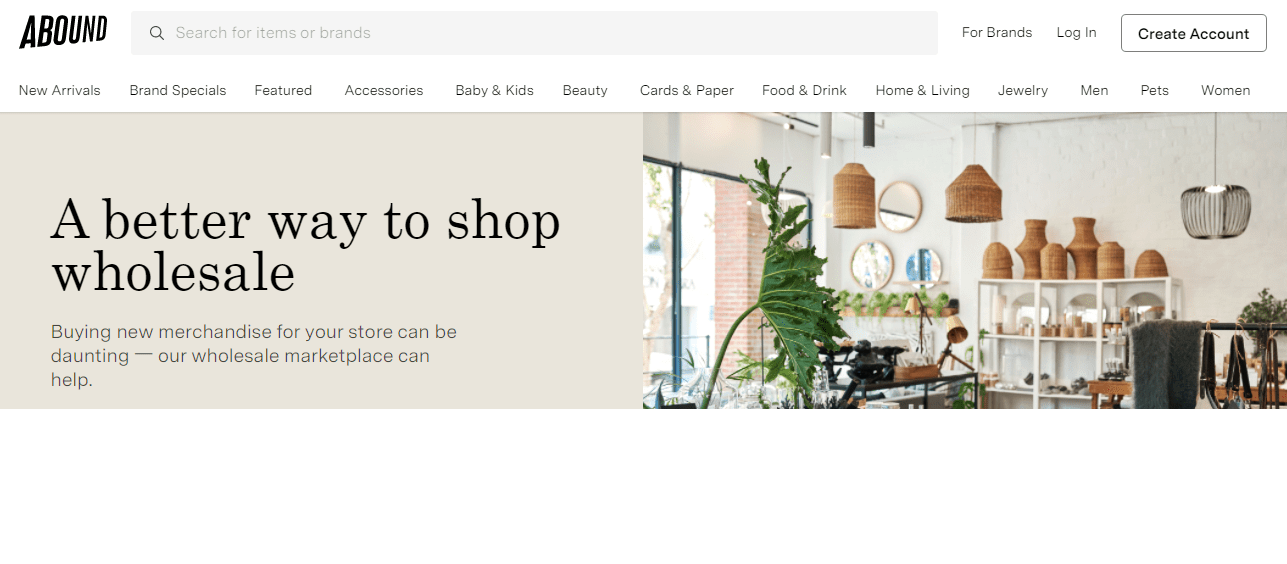
Best for: Boutique owners seeking curated, high-quality brands in gift, home, and specialty categories as a complement to Faire.
Key Numbers: 12,000+ brands | Net 60 payment terms | Free returns on first orders | Lower brand commission rates than Faire
The Faire Challenger with Editorial Ambitions
Abound has emerged as the most credible challenger to Faire's dominance in the independent boutique wholesale market, and it has done so by matching Faire's most important buyer protections — Net 60 terms, free returns on first orders, no minimum order requirements — while differentiating on curation philosophy and brand relationships.
The platform is smaller but tightly focused. Its brand catalog, while not as large as Faire's, is maintained with a degree of editorial selectivity that many buyers find superior for specific discovery use cases. Abound's team actively recruits brands that have a strong independent retail presence and a compelling story — the kinds of brands that resonate with boutique shoppers who value authenticity and craftsmanship over mass-market accessibility.
If Faire is the Amazon of independent wholesale, Abound aspires to be something closer to a curated boutique magazine for wholesale buyers — a place where every brand has been editorially considered before it appears in the catalog.
Strengths
Abound's curation quality is genuinely high, and for buyers fatigued by Faire's increasingly crowded catalog, it offers a more focused and considered browsing experience. Its Net 60 terms and free first-order returns match the industry's best buyer protections. Brand commission rates are meaningfully lower than Faire's, which means brands can often offer slightly better pricing on the platform. Abound is particularly strong in gift, stationery, home, and specialty wellness categories.
Limitations
Abound's brand catalog is significantly smaller than Faire's, which limits selection breadth. Its discovery algorithm and recommendation technology are less sophisticated. The buyer community and educational resources are less developed. Outside of gift and home categories, the selection becomes thin quickly.
The Verdict on Abound
Abound is best used as a secondary sourcing platform alongside Faire, not as a replacement. For boutiques that feel Faire's discovery has become overwhelming to navigate, Abound provides a quieter, more curated alternative for finding emerging brands. The matching buyer protections mean there is no financial downside to adding it to your sourcing stack.
4. Handshake by Shopify — The Native Wholesale Solution for Shopify Merchants
Best for: Shopify-based retailers and brands seeking a zero-commission, natively integrated wholesale channel within the Shopify ecosystem.
Key Numbers: Zero commission on transactions | Native Shopify integration for buyers and brands | Seamless inventory sync | Growing brand catalog within Shopify's merchant network
Shopify's Vertical Integration Play
Handshake represents Shopify's strategic move to own the entire commerce stack — from brand DTC storefront to wholesale distribution channel. Launched as a marketplace connecting Shopify-powered brands with retail buyers, Handshake's most compelling feature is its zero-commission model: Shopify does not take a cut of wholesale transactions made through the platform, positioning it as a powerful, cost-efficient alternative for brands already embedded in the Shopify ecosystem.
For retailers who are themselves on Shopify, the integration is seamless. Products purchased through Handshake can be pushed directly into a retailer's Shopify store, inventory is synced automatically, and the order management experience is entirely native. This dramatically reduces the operational friction of wholesale buying for Shopify merchants, who would otherwise manage wholesale purchases through a separate system.
Strengths
Zero commission is Handshake's headline advantage and it is a genuinely significant one — brands keep full margin on every transaction, which creates room for better wholesale pricing relative to commission-heavy platforms. The native Shopify integration eliminates the manual work of reconciling wholesale purchases with a retailer's existing inventory and storefront. No minimum orders on many products lower the barrier to discovery.
Limitations
Handshake's value proposition is strongest for retailers already on Shopify. For merchants on other platforms, the integration benefits disappear. The brand catalog remains smaller than Faire's and the discovery experience is less refined. Payment term options are limited compared to Faire's Net 60 offering.
The Verdict on Handshake
If you are a Shopify merchant and you are not using Handshake, you are leaving value on the table. The zero-commission structure and native integration create genuine operational and financial advantages within the Shopify ecosystem. For non-Shopify retailers, it is a secondary consideration.
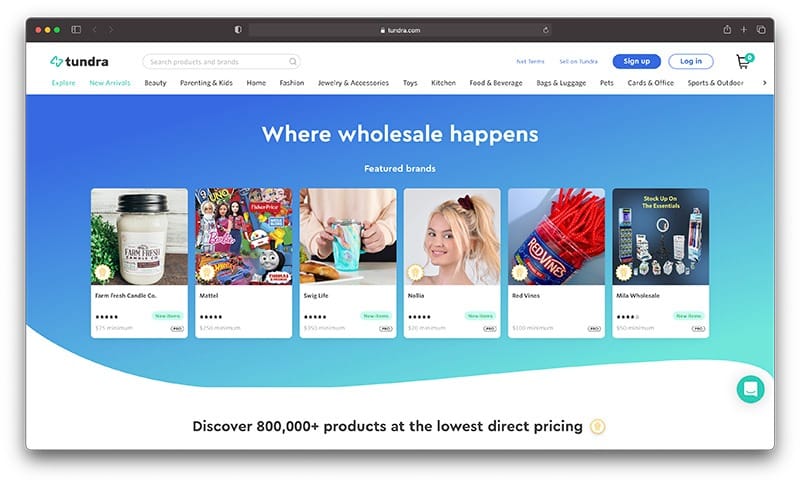
5. Tundra — The Zero-Commission Wholesale Marketplace
Best for: Cost-focused retailers looking for better unit pricing on reorders, and brands seeking a zero-cost distribution channel to complement Faire.
Key Numbers: Zero percent commission | Free shipping on qualifying orders | Multi-category coverage | Growing brand catalog across home, gifts, beauty, and food
The Case for Zero Commission
Tundra entered the market with a bold and simple pitch: a wholesale marketplace that charges brands absolutely nothing in commissions. While Faire takes 15–25% and other platforms take their own cuts, Tundra's model relies on optional premium services and advertising products to generate revenue — leaving brands with full margin integrity on every wholesale transaction.
For retailers, this structural difference translates into real pricing advantages. Because brands are not surrendering a commission, many can offer lower wholesale prices on Tundra than they can on Faire for equivalent products. Experienced retail buyers frequently use Tundra specifically to compare pricing on brands they already know, often finding better unit economics for high-volume reorders.
Strengths
Zero commission enables genuinely competitive wholesale pricing, particularly for reorders of proven products. Free shipping on qualifying orders further reduces landed costs. The platform covers a broad range of categories and has built a respectable catalog of brands willing to accept the trade-off of lower platform reach for better margin retention.
Limitations
Tundra lacks Faire's Net 60 terms and free return guarantees, which matters significantly for buyers testing new brands. The discovery and recommendation engine is less sophisticated, making it less useful for finding new brands and more useful for reordering known ones. The active brand catalog is smaller than the top platforms.
The Verdict on Tundra
Think of Tundra as a powerful complement to Faire rather than a competitor to it. Use Faire for discovery, brand testing, and new product exploration. Use Tundra for price-optimized reordering of brands you've already validated. The combination is financially intelligent.
6. Wholesale Central — The Original Online Wholesale Directory
Best for: Retailers sourcing domestic closeout, liquidation, or niche category merchandise, and buyers comfortable managing direct supplier relationships.
Key Numbers: Operating since 1996 | 1,400+ listed suppliers | US-domestic supplier focus | Free buyer access | Directory model with no transaction fees
The Veteran of Online Wholesale
Wholesale Central is one of the oldest online wholesale directories in the United States, having operated since 1996. Unlike the transactional platforms that dominate the modern landscape, Wholesale Central operates primarily as a directory — connecting retail buyers with suppliers but leaving the actual negotiation and transaction to occur directly between the parties.
This older model has underappreciated advantages. It generates no fees on transactions and exposes buyers to a wide range of suppliers, including many domestic manufacturers and liquidators not found on curated platforms. For retailers looking to source close-out merchandise, liquidation inventory, seasonal overstock, or domestic US-manufactured goods at sharp prices, Wholesale Central remains a genuinely useful resource.
It covers categories — including hardware, pet supplies, automotive accessories, seasonal goods, and novelty merchandise — that are underrepresented on the newer, lifestyle-focused platforms.
Strengths
Wholesale Central provides access to an extensive US-domestic supplier network built over nearly three decades. It covers niche categories that Faire and FashionGo largely ignore. There are no transaction fees since buyers deal directly with suppliers. The long-established supplier relationships on the platform carry a degree of implied credibility.
Limitations
The user interface is significantly dated relative to modern platforms and makes discovery cumbersome. There are no built-in payment terms, buyer protections, or return guarantees — all terms are negotiated directly between buyer and supplier. Variable supplier quality requires buyers to conduct their own due diligence before placing orders.
The Verdict on Wholesale Central
Wholesale Central is not a first-line sourcing platform for most modern boutiques, but it fills a real niche for buyers seeking closeout merchandise, domestic suppliers, or categories that the curated platforms underserve. It rewards patient, experienced buyers willing to do their own vetting work.
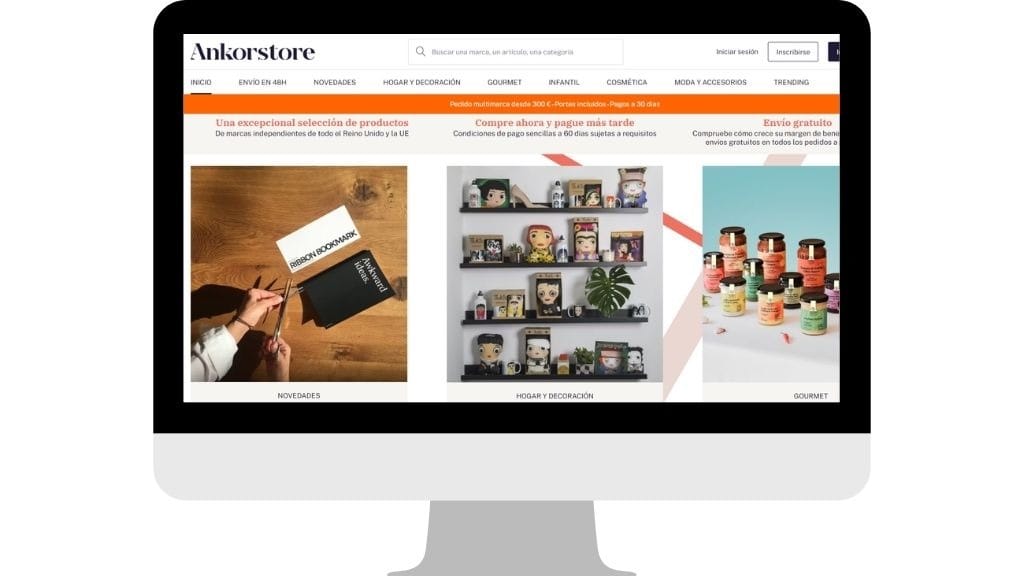
7. Ankorstore — Europe's Wholesale Leader, Now Expanding in the US
Best for: Retailers seeking differentiated European artisan products in home, specialty food, and lifestyle categories to stand out from competitors.
Key Numbers: 30,000+ brands | Net 60 payment terms | Platform return guarantees | Primary strength in European artisan categories | Expanding US brand catalog
Bringing European Craftsmanship to American Shelves
Ankorstore is France's answer to Faire — a wholesale marketplace founded in Paris that has rapidly scaled across Europe and is actively expanding into the US market. Its catalog features a remarkable selection of European independent brands: French candles, Italian leather goods, Scandinavian homeware, British fine foods, and specialty artisan products from across the continent.
For American retailers seeking genuine differentiation through unique, internationally sourced inventory, Ankorstore is an increasingly compelling option. European brands carry a premium perception with US consumers, and the storytelling opportunities — provenance, craftsmanship, heritage — are far richer than with most mass-produced domestic alternatives.
The platform's Net 60 terms and minimum-order-flexible structure parallel Faire's buyer-friendly approach. Its focus on small-batch, artisanal brands gives it a distinctive edge in a wholesale market increasingly saturated with mass-produced product.
Strengths
Ankorstore's selection of European independent brands is simply unavailable elsewhere in the US wholesale market. Net 60 terms and platform buyer protections match the industry's best buyer-friendly standards. The artisan and premium product positioning gives US retailers a genuine differentiation story for their customers. The platform is particularly strong in specialty food, home fragrance, ceramics, and lifestyle accessories.
Limitations
Longer shipping times from European suppliers can complicate inventory planning, particularly for fast-turn boutique needs. The US brand catalog is still developing, and category coverage outside European artisan products is limited. Currency considerations and import logistics require more operational planning than domestic platforms.
The Verdict on Ankorstore
Ankorstore is not a Faire replacement — it is a differentiation tool. For boutiques whose brand identity is built around curated, story-rich products with European provenance, it is one of the most valuable additions to a sourcing stack available in 2025.
8. Alibaba — The Global Manufacturing Behemoth
 Best for: Retailers developing private-label products, brands sourcing custom merchandise, and high-volume buyers seeking the lowest unit costs on manufactured goods.
Key Numbers: 200,000+ suppliers | Active in 190+ countries | $134 billion in revenue (2024) | Trade Assurance payment protection | OEM and ODM manufacturing capability
Source at Scale from Global Manufacturers
No wholesale sourcing guide would be complete without Alibaba — the world's largest B2B commerce platform by revenue and the gateway to the global manufacturing ecosystem. While Alibaba operates very differently from Faire or FashionGo (it is primarily a manufacturer and supplier marketplace, not a curated wholesale platform), it remains an essential tool for retail entrepreneurs who want to private label products, develop custom merchandise, or source at the lowest possible per-unit cost.
Alibaba's value proposition centers on direct-to-manufacturer sourcing. Buyers communicate directly with factories in China, India, Vietnam, Bangladesh, and dozens of other manufacturing hubs, negotiate custom specifications, place large-volume orders, and arrange shipping and quality control. For retailers building private-label product lines — apparel, electronics accessories, beauty tools, kitchen goods, promotional products — Alibaba is often the only realistic starting point.
The platform has invested heavily in trust and verification tools in recent years: Trade Assurance payment protection, supplier verification tiers, factory audit reports, and a dispute resolution system. These measures have substantially improved buyer confidence. Alibaba.com is distinct from AliExpress (which serves consumers) and is specifically designed for business buyers purchasing wholesale quantities.
Strengths
Alibaba offers unparalleled selection across virtually every product category on earth. The per-unit costs available through direct manufacturer sourcing are lower than any other platform on this list by a significant margin at volume. Custom manufacturing and private label capability allow retailers to build truly proprietary product lines. Trade Assurance provides meaningful payment protection for international transactions.
Limitations
Alibaba requires significant due diligence on suppliers — the verification tools help, but they do not eliminate the need for careful vetting, sample requests, and often third-party factory audits. Lead times are long, typically measured in weeks to months rather than days. Minimum order quantities are often high, particularly for custom manufacturing runs. Logistics, customs clearance, and import duties add complexity and cost that must be factored into landed cost calculations. Alibaba is not appropriate for fast-turn boutique reordering.
The Verdict on Alibaba
Alibaba is a foundational tool for any retail entrepreneur building a private-label strategy or seeking the lowest possible manufacturing costs at scale. It demands more operational sophistication than curated platforms, but the financial rewards for retailers who invest in that capability are substantial.
9. RangeMe — The Gateway to Major Retail Chains
Best for: Consumer brands seeking placement in major US retail chains, and chain category buyers looking to discover and evaluate new product lines efficiently.
Key Numbers: 200,000+ products listed | Used by Target, Walmart, Whole Foods, CVS, Kroger, and others | Subscription-based for brands | Owned by ECRM
Connecting Brands with National Retail Buyers
RangeMe operates on a fundamentally different model from every other platform in this guide. Rather than serving independent boutiques or wholesale buyers, it is a product discovery platform used by category buyers at major retail chains to evaluate new products for potential placement consideration.
The platform has become the standard submission portal for major US retailers seeking to refresh or diversify their product assortments. Brands submit detailed product profiles — including retail pricing, margin structures, UPC codes, certifications, and marketing assets — and chain buyers search and filter based on specific merchandising needs and category strategies. RangeMe has dramatically reduced the friction of the traditional retail pitch process, replacing cold calling and trade show introductions with a structured digital discovery layer.
If you are a consumer goods brand with ambitions to land on the shelves of major national or regional chains, RangeMe is the most direct path available to put your product in front of the buyers who make those decisions.
Strengths
RangeMe provides direct structured access to category buyers at the most important retail chains in the United States — buyers who would otherwise be nearly impossible to reach through traditional sales channels. A well-maintained brand profile on the platform functions as a permanent, searchable pitch that buyers can discover at any time. The platform's analytics tools on premium tiers help brands understand how their profiles are performing and which categories are getting the most buyer attention.
Limitations
RangeMe is not a platform for independent boutique sourcing — it serves an entirely different purpose. A meaningful brand presence on the platform requires a paid subscription, and competition is fierce, with thousands of brands competing for the attention of the same category buyers. The platform facilitates discovery but does not manage transactions or negotiations, which must still happen through traditional retail buying processes.
The Verdict on RangeMe
For consumer brands with the scale, margin structure, and operational capacity to supply major retail chains, RangeMe is among the most valuable platform investments available. A professionally maintained profile with strong photography, clear margin economics, and compelling brand storytelling is the cost of entry to serious consideration by chain retail buyers.
10. TradeKey — Global B2B Trade for Emerging Market Sourcing
Best for: Retailers and importers looking to source textiles, apparel, or industrial goods from South Asian supply chains as part of a diversified global sourcing strategy.
Key Numbers: 9 million+ members | Active in 240+ countries | Strong in Pakistan, India, Bangladesh, UAE supply chains | Free basic buyer access | Particular strength in textiles and industrials
An Alibaba Alternative for Global Sourcing
TradeKey serves as an alternative global B2B trade platform with particular strength in South Asian and Middle Eastern supply chains. With over 9 million members across 240 countries, it offers broad exposure to manufacturers and traders across Pakistan, India, Bangladesh, the UAE, and China. For US retailers looking to diversify their sourcing geography beyond China — particularly for textile and apparel goods — TradeKey provides genuine value as a complement to Alibaba.
The platform operates as a lead generation and connection directory: buyers post sourcing requests, suppliers respond with quotes, and the parties negotiate independently. It is less refined than Alibaba in terms of verification tools and trade protection services, but it accesses different supplier networks — particularly strong in textiles, agricultural commodities, leather goods, and industrial products.
Strengths
TradeKey provides meaningful access to South Asian and Middle Eastern manufacturing ecosystems that are underrepresented on Alibaba. It is particularly strong in textile and apparel manufacturing from Pakistan and Bangladesh. Free basic access to post sourcing requests lowers the barrier to entry. For retailers actively diversifying their supply chain geography for cost or risk reasons, it is a useful discovery tool.
Limitations
Supplier verification tools are less rigorous than Alibaba's, requiring buyers to conduct more independent due diligence. The user interface is significantly dated. The platform is more useful for brands and importers building manufacturing relationships than for boutique retailers looking for finished goods reorders. Quality control must be actively managed.
The Verdict on TradeKey
TradeKey is a specialist tool for a specific use case: sourcing from South Asian and Middle Eastern manufacturing hubs, particularly for textiles, apparel, and industrial goods. It is not a platform for most independent boutique retailers, but for the growing number of US entrepreneurs building diversified global supply chains, it deserves a place in the research toolkit.
How to Choose the Right Marketplace — or the Right Combination
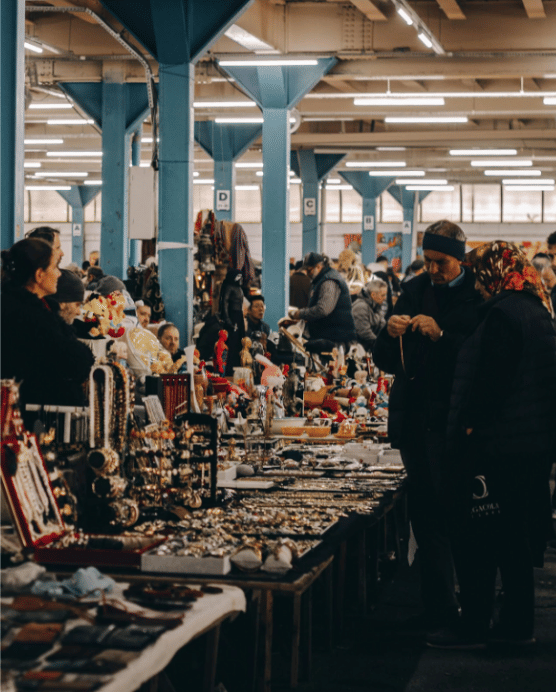
The most sophisticated retail entrepreneurs do not use a single wholesale marketplace. They use a considered stack of platforms optimized for different sourcing goals. Understanding how to layer these platforms is as important as choosing the right primary one.
For the independent lifestyle boutique, the answer is almost always Faire first. Its combination of Net 60 terms, free returns on new brands, and exceptional discovery is purpose-built for that use case. Once a core assortment is established on Faire, adding Abound for curated specialty finds and Tundra for zero-fee reordering of high-volume staples creates a genuinely powerful sourcing system. If European differentiation matters to the boutique's brand story, Ankorstore rounds out the stack for seasonal discovery.
For the fashion retailer, FashionGo is non-negotiable as a primary platform — nothing else comes close for apparel depth and trend velocity. Faire works powerfully as a secondary platform for accessories, jewelry, gifts, and lifestyle items that round out the floor. FashionGo's dropship program is worth serious consideration for retailers with a meaningful online channel.
For the Shopify-native e-commerce merchant, Handshake deserves consideration as a zero-commission wholesale channel. Combined with Faire's reach and Tundra's pricing advantages, a Shopify merchant can build a powerful, low-cost sourcing stack.
For the retailer building a private-label line, Alibaba is the indispensable starting point for manufacturing relationships, with TradeKey offering supplementary access to South Asian textile manufacturing. Maintaining ready-made inventory through Faire or Handshake during the product development cycle prevents stock gaps while private-label timelines develop.
For the ambitious brand seeking major retail placement, RangeMe is the platform-specific investment worth making. A professionally maintained RangeMe profile is the cost of entry to serious consideration by chain retail buyers — and many brands have landed regional and national chain deals through it that would have taken years through traditional sales channels.
The Bottom Line for Retail Entrepreneurs in 2025
The B2B wholesale marketplace landscape has never been more favorable for independent retail entrepreneurs. The combination of platform competition, financial innovation — Net 60 terms, buy-now-pay-later, free returns — and technology sophistication has fundamentally shifted power from brands and distributors toward buyers.
A boutique owner in 2025 has access to the same brands, the same pricing structures, and many of the same financial tools that a mid-size regional chain buyer had fifteen years ago. That democratization is the defining story of this industry, and the platforms on this list are its primary engines.
Faire.com remains the benchmark for the independent wholesale experience: its risk-reduction innovations, discovery quality, and community depth set a standard that competitors are still working to match. FashionGo holds its own with unmatched apparel depth and a vendor ecosystem that simply cannot be replicated. Together, these two platforms cover the core of what most American retail entrepreneurs need — and the eight platforms below them serve specific niches, use cases, and business models that the leaders cannot fully address.
The smartest move a retail entrepreneur can make is not to find the one perfect platform. It is to build a sourcing strategy that leverages the right tools for each objective. Use Faire for discovery and risk-free exploration. Use FashionGo for fashion velocity. Use Tundra or Handshake for zero-fee reordering. Use Alibaba for private-label ambitions. Use RangeMe if you are a brand with chain retail dreams. These platforms are not competitors for your loyalty — they are tools in your entrepreneurial toolkit, each designed for a different job.
The wholesale revolution is not slowing down. Platforms are racing to add embedded financing, AI-powered trend forecasting, vertical-specific tools, and deeper logistics integration. The retail entrepreneur who invests time in understanding and mastering these platforms today will have a structural advantage over competitors still placing trade show orders and waiting on catalog deliveries. The tools are here. The opportunity is now.
Download the PREPP App and attempt FREE Scholarship Mock Tests and get complete study material!


Comments