REM in Toxicology - Environment Notes
REM is a measure of the amount of radiation that is given to people (such as from X-rays). The acronym "rem," which is derived from the term "Roentgen equivalent man," is currently used to refer to the dose in rads that will result in biological damage equivalent to that caused by one rad of X-rays or gamma rays. The term relative biological effectiveness (RBE), which had previously been ill-defined, was made clearer in 1962 to be used in radiobiology and radiation protection. This article will explain to you about REM in Toxicology which will be helpful in preparing the Environment Syllabus for the UPSC Civil Service exam.
|
Table of Contents |
REM - Background
- The term "rem" first appeared in literature in 1945, and in 1947 it received its first meaning.
- The term was changed to "that dose of any ionizing radiation which generates a significant biological effect comparable to that produced by one roentgen of high-voltage x-rays" in 1950.
- The REM was variously estimated to be 83, 93, or 95 erg/gram using data that was accessible at the time.
- The ICRP opted to keep using the rem despite the advent of the rad in 1953.
- The ICRP began suggesting levels of relative biological effectiveness (RBE) for various types of radiation in 1962 and formally established the rem as the unit of equivalent dose to assess how different types of radiation disperse energy in the tissue.
- In actuality, the unit of rem was employed to indicate the application of an RBE factor to a quantity that was initially expressed in rad or roentgen units.
What is REM?
- The term "rem" refers to a CGS (Centimetre–gram–second system of units) unit that combines the terms "equivalent dose," "effective dose," and "committed dose," all of which are dosage measurements that are used to calculate the possible health consequences of low doses of ionizing radiation on the human body.
- The stochastic biological risk of ionizing radiation, which mostly consists of cancer from radiation exposure, is intended to be represented by quantities measured in rem.
- These amounts are obtained from the absorbed dose, which is measured in rad in the CGS system.
- The ratio of relative biological efficacy (RBE) determines the rad to rem conversion because there is no generally applicable conversion constant.
- In the International System of Units (SI), one rem is equivalent to one sievert.
What is Radiation?
- The energy that originates from a source and moves through space at the speed of light is referred to as radiation.
- This energy has wave-like qualities and is accompanied by an electric field and a magnetic field.
- Background radiation is a type of radiation that all living organisms are constantly exposed to.
- When the level of radioactive radiation exceeds a certain threshold, it causes damage to living organisms.
What is Radiation Dose?
- The dose of radiation is not the same as the dose of medication.
- Ionizing radiation leaves energy behind when it enters an object or the human body.
- A dose is the amount of energy that is absorbed during radiation exposure.
- There are three ways to describe radiation dosage quantities: absorbed, equivalent, and effective.
- The unit of radioactivity is Becquerel (SI unit) or Curie. The Sievert is the unit for the measurement of the quantity of radiation absorbed by the human tissues.
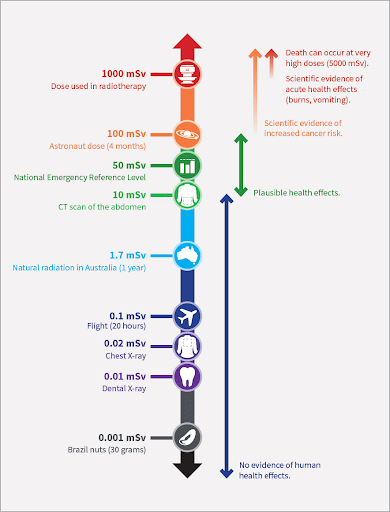
Radiation Doses
REM - Health Effects
- The effects of ionizing radiation on human health are both deterministic and stochastic.
- Only in the presence of high doses and high dose rates do the deterministic effects that can result in acute radiation sickness take place.
- Different weighting criteria than those employed in the calculation of equivalent and effective dose would be necessary for a model of deterministic risk.
- To minimize confusion, deterministic effects are typically measured in units of rad rather than rem when compared to the absorbed dose.
- Stochastic effects are those that happen at random, such as cancer brought on by radiation.
- The incidence of malignancies brought on by ionizing radiation can be predicted as increasing linearly with effective dosage at a rate of 0.055% per rem, according to the nuclear industry, nuclear regulators, and governments.
- Other risk estimates have been developed all across this consensus model, due to individual studies, alternative models, and older iterations of the industry consensus.
- Although there is no quantifiable agreement, it is generally agreed that the risk is larger for children and fetuses than for adults, for middle-aged people than for seniors, and for women than for males.
- Regarding the possibilities of cardiac and teratogenic consequences, as well as the modeling of internal dose, there is far less information and much more debate.
- Without taking into account medical and occupational exposures, the ICRP advises limiting artificial irradiation of the public to an average of 100 mrem (1 mSv) of effective dosage per year.
Conclusion
The amounts and units of radiation exposure are inherently more complex than those employed in toxicology or pharmacology, and further complexity has emerged from various revisions necessitated by evolving notions in radiation dosimetry.
FAQs
Question: What is REM in toxicology?
Answer: REM (Reference Exposure Model) in toxicology refers to a tool used for estimating the exposure levels of humans to various toxic substances. It calculates the concentration of harmful substances in the environment and estimates potential risks of exposure to these chemicals based on certain assumptions and exposure scenarios.
Question: How is REM used to assess human health risks?
Answer: REM is used to assess human health risks by modeling the exposure of individuals to toxic chemicals. The model considers various factors such as the duration, frequency, and pathway of exposure to estimate the potential adverse health effects. It helps in determining safe exposure limits and informs regulatory decisions on chemical safety.
Question: What factors are considered in REM for calculating toxic exposure?
Answer: Factors considered in REM include the chemical's concentration in air, water, or soil, the duration and frequency of exposure, the specific population group (e.g., children, adults), and the bioavailability of the toxic substance. These variables help predict the possible toxicological effects of the substance on human health.
Question: Why is REM important in environmental toxicology?
Answer: REM is important in environmental toxicology because it provides a scientific approach to estimate human exposure to environmental toxins. It helps regulatory bodies set safety standards for chemical exposures, guides risk assessments, and ensures that public health is protected from harmful environmental pollutants.
Question: Can REM be used for long-term environmental monitoring?
Answer: Yes, REM can be used for long-term environmental monitoring. By continuously assessing toxic exposure levels, the model can track the effectiveness of regulatory measures and identify areas where exposure may exceed safe limits. It helps in making informed decisions to mitigate risks over time.
MCQs
1. What does REM stand for in toxicology?
A. Risk Exposure Model
B. Reference Exposure Model
C. Regulatory Exposure Model
D. Risk Evaluation Model
Answer: (B) See the Explanation
REM stands for Reference Exposure Model, which is used in toxicology to estimate human exposure to harmful substances and assess potential health risks.
2. Which of the following factors is NOT considered in REM for calculating toxic exposure?
A. Chemical concentration
B. Duration of exposure
C. Age of the population
D. Geographical location of the chemical
Answer: (D) See the Explanation
Geographical location is not a direct factor considered in REM for calculating toxic exposure. The model focuses on chemical concentration, exposure duration, frequency, and the specific population's characteristics.
3. What is the main purpose of using REM in environmental toxicology?
A. To predict climate change impacts
B. To estimate human exposure to toxins
C. To measure pollution levels
D. To track economic costs of pollution
Answer: (B) See the Explanation
The main purpose of REM is to estimate human exposure to toxic substances and assess potential health risks. It helps in understanding the impact of pollutants on human health.
4. Why is REM considered a valuable tool in toxicology?
A. It provides accurate environmental pollution data
B. It helps in estimating human exposure to toxins
C. It helps in developing new chemicals
D. It tracks the source of toxins
Answer: (B) See the Explanation
REM is valuable because it helps in estimating human exposure to toxic substances, enabling better risk assessments and decision-making for public health safety.
5. Which of the following can REM help identify?
A. Chemical toxicity levels
B. Safe exposure limits
C. Environmental pollutants
D. All of the above
Answer: (D) See the Explanation
REM can help identify chemical toxicity levels, assess safe exposure limits, and evaluate environmental pollutants to ensure public health protection.
GS Mains Questions and Model Answers
1. Discuss the role of REM in human health risk assessment in environmental toxicology.
Answer: REM plays a crucial role in human health risk assessment in environmental toxicology by quantifying exposure to toxic substances. It models potential pathways of exposure—through air, water, soil, or food—and evaluates the effects on different population groups. This allows for the estimation of health risks associated with pollutants and helps in setting regulatory limits to protect public health. It also aids in prioritizing hazardous substances and guiding intervention measures to reduce exposure, thus playing a critical role in environmental health management.
2. Evaluate the challenges associated with using REM in toxicological assessments.
Answer: One challenge with REM is the uncertainty in modeling exposure pathways and concentrations of toxic substances, as environmental conditions and human behaviors can vary widely. Additionally, accurate data on chemical release and human exposure are often difficult to obtain, which may lead to inaccurate risk assessments. Another challenge is the complexity of accounting for cumulative and synergistic effects of multiple pollutants. To improve REM's reliability, more precise data collection methods and advanced modeling techniques are required to account for real-world variability.
3. How can REM help in formulating environmental policies?
Answer: REM can help in formulating environmental policies by providing scientific data on human exposure to environmental pollutants. By estimating the health risks associated with various toxins, REM can guide the development of exposure limits, pollution control regulations, and public health initiatives. It assists policymakers in prioritizing pollutants that require immediate action, evaluating the effectiveness of existing policies, and designing targeted interventions to reduce toxic exposure in vulnerable populations. This ensures that policies are based on sound scientific evidence and aimed at reducing environmental health risks.
Previous Year Questions on Environmental Toxicology
1. UPSC CSE Prelims 2020
Question: What does the Reference Exposure Model (REM) in toxicology aim to assess?
A. Chemical reactions
B. Environmental pollution
C. Human exposure to toxins
D. Global warming
Answer: C
Explanation: The Reference Exposure Model (REM) is designed to assess human exposure to toxic substances and estimate potential health risks from environmental pollutants.
Download the PREPP App and attempt FREE IAS Exam Mock Tests and get complete study material!
UPSC IAS : GS - Indian Economy - Subject Knowledge Test

Live Test : UPSC CSE Prelims CSAT (Paper-II) (July 22 - 25)
UPSC CSE Prelims 2026 GS Paper 1 Question Paper (24-May-2026)
UPSC CSE Prelims 2026 CSAT Paper 2 Question Paper (24-May-2026)

17 February 2025 | The Hindu Must Read Articles | Current Affairs

16 February 2026 | The Hindu Must Read Articles | Current Affairs

13 February 2026 | The Hindu Must Read Articles | Current Affairs









Comments