Agenda 21 is a United Nations (UN) action plan for sustainable development that was produced as a result of the 1992 Rio de Janeiro, Brazil, UN Conference on Environment and Development (UNCED). It is a comprehensive action plan for UN organizations, governments, and significant groups to follow in every area where people directly impact the environment on a global, national, and local level. An agenda for the twenty-first century is denoted by the number 21. This article will explain to you about Agenda 21 which will be helpful in preparing the Environment Syllabus for the UPSC Civil Service exam.
![Mains Test Series for UPSC 2026]()
Agenda 21
What is Agenda 21?
- The United Nations' Agenda 21 is a non-binding action plan for sustainable development.
- It is a result of the 1992 Rio de Janeiro, Brazil, Earth Summit, a United Nations conference on environment and development.
- It is an action plan that may be carried out at the local, national, and international levels by the UN, other multilateral organizations, and various sovereign governments.
- Every local government should create its own local Agenda 21 as one of the project's main goals.
- The initial goal of Agenda 21 was to achieve global sustainable development by the year 2000; the "21" in the name refers to the intended year of the 21st century.
- More than 178 governments adopted Agenda 21, the Rio Declaration on Environment and Development, and the Statement of Principles for the Sustainable Management of Forests at the United Nations Conference on Environment and Development (UNCED) in Rio de Janeiro, Brazil, from June 3 to 14, 1992.
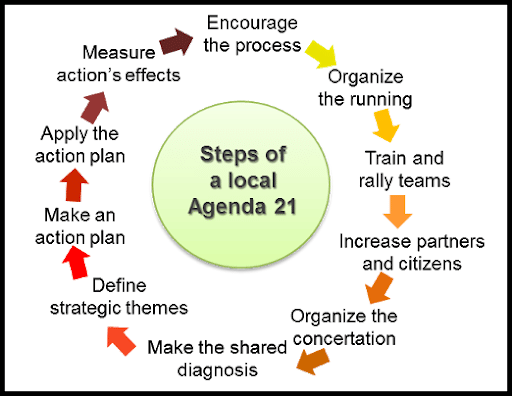
![Phases of Agenda 21 at Local Level]()
Phases of Agenda 21 at Local Level
Structure
Agenda 21 - Structure
- Section I (Social and Economic Dimensions): The goals of Section I are to reduce poverty, especially in emerging nations, alter consumption patterns, advance health, increase population sustainability, and integrate sustainability into decision-making.
- Section II (Conservation and Management of Resources for Development): Protecting the atmosphere, stopping deforestation, safeguarding vulnerable ecosystems, preserving biological diversity, reducing pollution, managing biotechnology, and managing radioactive wastes are all topics covered in Section II.
- Section III (Strengthening the Position of Major Groups): The responsibilities of children and youth, women, NGOs, local authorities, business and industry, and workers are discussed in Section III. Additionally, the role of indigenous peoples, their communities, and farmers is strengthened.
- Section IV (Means of Implementation): Science, technological transfer, education, international institutions, and financial mechanisms are all included in Section IV.
Implementation
Agenda 21 - Implementation
- The Commission on Sustainable Development serves as a high-level forum on sustainable development and has served as a planning body for summits and sessions on putting Agenda 21 into action.
- The Commission's secretariat is the UN Division for Sustainable Development, which operates "within the framework of" Agenda 21.
- Its adoption has varied, and member state implementation is still discretionary.
- Action at the world, national, regional, and local levels were meant to be a part of the implementation of Agenda 21.
- Local level: Some national and state governments have passed laws or given guidance directing local governments to carry out the plan locally, as suggested in Chapter 28 of the document. These initiatives are frequently referred to as "Local Agenda 21" or "LA21."
- Regional Levels: The UN Department of Economic and Social Affairs Division for Sustainable Development tracks and assesses the development of Agenda 21 in each country, and it publishes these reports online for the general public to view.
- Over 6400 local governments were identified as participating in Local Agenda 21 initiatives in 113 countries by the Rio+10 report, a more than three-fold growth in less than five years. 5120 local governments, or 80% of them, were found in Europe.
- There has been a noticeable rise in the number of nations with active LA21 procedures, with some even having multiple processes going on at once.
Significance
Agenda 21 - Significance
- Agenda 21 addresses today's pressing issues while also preparing the world for the challenges of the next century.
- It reflects a global consensus and high-level political commitment to development and environmental cooperation.
- Governments are primarily responsible for its successful implementation. National strategies, plans, policies, and processes will be essential in accomplishing this.
- Such national efforts should be supported and supplemented by international cooperation.
- The United Nations system plays an important role in this context. Other international, regional, and subregional organizations are also being asked to help with this effort.
- The broadest possible public participation, as well as the active participation of non-governmental organizations and other groups, should be encouraged.
Successes
Agenda 21 - Successes
- The idea of sustainable development was introduced into popular culture through Agenda 21 (and the original Rio Earth Summit in general), if not quite making it a household term.
- It had a significant impact on the terminology used in later international papers and accords.
- In contrast to more technologically driven "solutions" in the so-called "development decades" of the 1960s and 1970s, Agenda 21 has helped put the idea of sustainable human development at the center of development.
- By establishing the Commission on Sustainable Development (CSD), Agenda 21 attempted to address the problem of integrating environmental and developmental.
- Possibly Agenda 21's best accomplishment has been raising expectations for what sustainable outcomes are feasible on a sector-by-sector basis.
- For instance, Agenda 21 has significantly increased our knowledge of biodiversity, the role agriculture plays in the development and the place of indigenous peoples in society.
Challenges
Agenda 21 - Challenges
- In retrospect, the sector-based structure of Agenda 21 may have made the idea of integration, which is at the core of sustainable development and aims to promote cross-sectoral solutions, less effective.
- Another problem is that Agenda 21 left out several industries. The document's all-inclusive character was compromised by this.
- For instance, important industries like mining and electricity were not featured as separate chapters.
- While production systems have improved in efficiency, consumption patterns seem to have gotten worse.
- This trend is aided and abetted by production's globalization, and there aren't many national policies or strategies in place to encourage adjustments in unsustainable consumption patterns.
Conclusion
Conclusion
Twenty years after the Earth Summit, Agenda 21 is still highly relevant and is still the UN system's most comprehensive effort to promote sustainable development. The problems that humanity is facing today are more or less identical to those addressed in the chapters of Agenda 21, despite significant coverage gaps. Although Agenda 21 has received a lot of attention from nation states, neither its implementation nor its efficacy has been fully realized. The majority of Agenda 21's goals have still not been attained, notwithstanding certain components of excellent practice and spotty progress.
FAQs
FAQs
Question: What is Agenda 21?
Answer: Agenda 21 is a comprehensive action plan developed at the United Nations Conference on Environment and Development (UNCED) in Rio de Janeiro, 1992, aimed at achieving sustainable development globally.
Question: What are the key objectives of Agenda 21?
Answer: The main objectives include promoting sustainable development, addressing environmental challenges, and improving the quality of life for all people without depleting natural resources.
Question: What are the four sections of Agenda 21?
Answer: Agenda 21 is divided into four sections: Social and Economic Dimensions, Conservation and Management of Resources, Strengthening the Role of Major Groups, and Means of Implementation.
Question: What role do local governments play in implementing Agenda 21?
Answer: Local governments are crucial in implementing sustainable development initiatives at the grassroots level, in line with the principles outlined in Agenda 21.
Question: How does Agenda 21 address climate change?
Answer: Agenda 21 promotes reducing greenhouse gas emissions, protecting forests, and ensuring sustainable use of resources to mitigate the effects of climate change.
MCQs
MCQs
- In which year was Agenda 21 adopted?
a) 1995
b) 1992
c) 2000
d) 1987
Answer: (B) See the explanation
Agenda 21 was adopted at the Earth Summit (UNCED) in Rio de Janeiro in 1992.
- Which of the following is a key focus area of Agenda 21?
a) Global financial reform
b) Conservation of biodiversity
c) Expansion of industrial production
d) Military security
Answer: (B) See the explanation
Agenda 21 focuses on the conservation of natural resources and biodiversity to promote sustainable development.
- How many sections does Agenda 21 have?
a) Three
b) Four
c) Five
d) Six
Answer: (B) See the explanation
Agenda 21 is divided into four sections: Social and Economic Dimensions, Conservation of Resources, Major Groups' Role, and Implementation Means.
- Which international conference led to the formulation of Agenda 21?
a) Kyoto Protocol
b) Rio Earth Summit
c) Montreal Protocol
d) Paris Climate Agreement
Answer: (B) See the explanation
Agenda 21 was a result of the 1992 United Nations Earth Summit held in Rio de Janeiro.
- Which of the following is a critical strategy under Agenda 21 for sustainable development?
a) Industrial deregulation
b) Expansion of urbanization
c) Reduction of poverty and improving health care
d) Taxing industrial waste
Answer: (C) See the explanation
One of the objectives of Agenda 21 is to reduce poverty and improve healthcare systems as part of sustainable development.
GS Mains Questions with Explanations
Q1: Discuss the significance of Agenda 21 in promoting sustainable development worldwide.
Explanation: Agenda 21 was designed to address environmental degradation and socio-economic challenges. It aims to promote sustainable development by integrating environmental protection, poverty reduction, and health improvements. By encouraging global collaboration, local involvement, and policy reforms, Agenda 21 seeks to balance economic growth with environmental sustainability.
Q2: How does Agenda 21 address the issue of sustainable resource management?
Explanation: Agenda 21 emphasizes the conservation and sustainable use of natural resources like water, energy, and biodiversity. It promotes policies for resource efficiency, sustainable agriculture, deforestation control, and ecosystem management. The document advocates for practices that minimize environmental impact while maximizing resource longevity.
Q3: Evaluate the role of local governments in implementing Agenda 21 at the grassroots level.
Explanation: Local governments are crucial in translating Agenda 21’s global goals into actionable plans. They are responsible for community-based initiatives, including urban planning, waste management, and sustainable infrastructure. Through local Agenda 21 programs, governments work directly with communities to promote environmental awareness and sustainable living.
Previous Year Questions on Agenda 21 - Environment Notes
1. UPSC CSE Prelims 2017:
Question: What is the primary focus of Agenda 21?
A. Economic growth
B. Global trade
C. Sustainable development
D. Military cooperation
Answer: C
Explanation: Agenda 21 is a comprehensive plan of action adopted at the 1992 Earth Summit in Rio de Janeiro, focusing on sustainable development, including environmental protection, social equity, and economic growth at local, national, and global levels.
2. UPSC CSE Mains 2015 (GS Paper 3):
Question: Discuss the relevance of Agenda 21 in promoting sustainable development in India.
Answer: Agenda 21 emphasizes local and global actions to achieve sustainable development. In India, it aligns with government policies focused on environmental protection, poverty eradication, and social inclusion. The plan encourages local governance (through Local Agenda 21), which has been reflected in India’s efforts towards decentralization, conservation, and inclusive growth, promoting sustainability at the grassroots level.














Comments